 Hans-Joachim Guth
Whether it’s a trade business, a field service organization, or a service company—without vehicles, many small and medium-sized businesses would grind to a halt. But the larger the fleet becomes, the more challenging it is to manage. Maintenance schedules, driver’s license checks, lease agreements, claims management, and rising costs all need to be reliably coordinated.
While smaller fleets are often still managed using Excel spreadsheets and manual processes, these solutions quickly reach their limits as the number of vehicles increases. Professional fleet management helps companies control costs, automate processes, and maintain an overview of their entire fleet.
Contents
- 1. What is fleet management?
- 2. Why Professional Fleet Management Is Crucial for Small and Medium-Sized Businesses
- 3. The Organizational Foundation: Clear Roles and Responsibilities
- 4. Standardizing Processes: The Key to Scaling Up
- 5. Insourcing vs. Outsourcing: Finding the Right Balance
- 6. Digitalization as a Key to Success for Small and Medium-Sized Businesses
- 7. Comprehensive Fleet Management: What Fleet Managers at Mid-Sized Companies Really Need
- 8. Electric Vehicles in Medium-Sized Company Fleets
- 9. Efficiency as a Key Competitive Advantage
- 10. How to Succeed at Modern Fleet Management in Small and Medium-Sized Businesses
What is fleet management?
Fleet management involves the administration, control, and optimization of all of a company’s vehicles. The goal is to operate the fleet in a cost-effective, efficient, and legally compliant manner. The most important tasks include:
- Vehicle procurement
- Contract and Lease Management
- Maintenance and Repair Planning
- Claims Management
- Cost Control
- Compliance with Legal Requirements
In addition, strategic tasks are becoming increasingly common: Climate and environmental goals, the integration of electric vehicles, the management of external service providers, and reporting are now part of the range of responsibilities for modern fleet managers at medium-sized companies. As a result, the role is increasingly evolving from pure vehicle management to the management of the company’s entire mobility operations.
That is why many companies rely on fleet management software to centrally manage vehicle data, analyze costs transparently, and automate recurring processes.
Why Professional Fleet Management Is Crucial for Small and Medium-Sized Businesses
With each additional vehicle, not only do costs rise, but so do organizational demands. Maintenance schedules, lease agreements, insurance claims, and legal obligations must be reliably planned, monitored, and documented.
What is still manageable with ten vehicles quickly becomes a challenge when there are 50 or more.
Based on our many years of experience in digital fleet management, we know that many medium-sized companies struggle not with a lack of data, but with a lack of transparency. Information is scattered across various systems, files, and contacts. This makes it difficult to control costs, increases administrative burdens, and poses risks when it comes to compliance with legal requirements.
Professional fleet management establishes clear processes and provides a centralized overview of vehicles, drivers, costs, and schedules. This not only allows administrative tasks to be handled more efficiently but also enables well-informed decisions —from vehicle procurement to fleet electrification.
The Organizational Foundation: Clear Roles and Responsibilities
Efficient fleet management in small and medium-sized businesses begins with clearly defined responsibilities. As the fleet grows, it becomes even more important to clearly define tasks, responsibilities, and decision-making processes.
- Management sets the strategic direction: It defines the mobility strategy, budget guidelines, outsourcing strategy, and company car policies. At the same time, it bears the fundamental responsibility as the vehicle owner.
- Fleet management is responsible for both operational and strategic oversight: This includes vehicle procurement, contract and claims management, reporting, controlling, driver’s license checks, driver training, and cost optimization. As a result, the traditional fleet manager is increasingly becoming a mobility manager.
- Interfaces with other departments—such as Purchasing , HR, Finance, Occupational Safety, and Controlling—play a role in numerous decisions. Close collaboration is particularly beneficial when it comes to vehicle procurement, the car policy, and leasing strategy.
Standardizing Processes: The Key to Scaling Up
Many medium-sized companies grow faster than their internal fleet management processes. The result: more coordination effort, a lack of transparency, and unnecessary sources of error. Standardized processes lay the foundation for efficient and scalable fleet management.
Car Policy as the Foundation of Fleet Management
A clearly defined company car policy ensures transparency and consistent decision-making. Among other things, it governs vehicle classes, budget guidelines, user groups, the personal use of company cars, as well as driver responsibilities and claims procedures.
The more clearly the car policy is defined, the less administrative work is required in day-to-day operations. At the same time, it provides guidance for employees and increases legal certainty within the company.
Strategically Managing Procurement and Leasing
The requirements for vehicle procurement have changed significantly in recent years. In addition to cost, flexibility, availability, energy consumption, and CO₂ emissions now play an important role.
Important questions that fleet managers should ask themselves include:
- Full-service leasing or partial services?
- Brand loyalty or a multi-brand strategy?
- Should You Buy or Lease Special-Purpose Vehicles?
- Centralized or decentralized procurement?
Companies must decide which leasing and service models are best suited for their fleet and which tasks should be handled internally or by external partners. A well-thought-out procurement strategy helps control costs and ensure the fleet is future-proof in the long term.
The BME guide shows that, particularly for larger fleets, a combination of internal management functions and external services is advisable.
Keeping Track of Deadlines and Operator Obligations
Regardless of the number of vehicles in the fleet, driver’s license checks, occupational safety training, maintenance schedules, vehicle inspection (HU) and emissions testing (AU) appointments, as well as documentation requirements, must be regularly monitored and documented in a verifiable manner.
Missing or inadequate processes can not only result in additional work but also entail significant liability risks in the event of damage. That is why structured management of maintenance schedules and operator responsibilities is one of the most important tasks in professional fleet management.

Insourcing vs. Outsourcing: Finding the Right Balance
These days, hardly any medium-sized company handles all of its fleet management processes in-house. At the same time, not every task is automatically better handled by an external service provider. The challenge lies in finding the right balance between in-house management and external services (fleet management outsourcing).
Which tasks should remain internal
Strategic tasks are closely linked to corporate goals and are therefore often handled internally. These include, for example:
- Car Policy
- Budget Planning
- Strategic Fleet Management
- Communication with Drivers and Service Providers
These areas require company-specific knowledge and form the foundation for a long-term mobility strategy.
External service providers help lighten the load in day-to-day operations
Operational tasks such as claims management, tire and registration services, and fuel card management are often outsourced to specialized service providers.
The advantage: External providers have specialized processes, digital platforms, and standardized procedures. This allows administrative tasks to be handled more efficiently and helps relieve the burden on internal resources in a targeted manner.
Don’t outsource everything—and don’t do everything yourself
Our experience working with medium-sized companies shows that there is no one-size-fits-all solution for all businesses. While some companies benefit from a high degree of outsourcing, others deliberately opt for more internal control.
The key issue is not whether tasks are handled internally or externally, but which solution creates the greatest added value. Successful fleet management organizations therefore combine strategic autonomy with the efficiency benefits of specialized service providers.
Digitalization as a Key to Success for Small and Medium-Sized Businesses
Many small and medium-sized businesses still manage their fleets using Excel spreadsheets and manual processes. However, the more complex fleet management becomes, the more difficult it is to efficiently manage schedules, costs, and vehicle data.
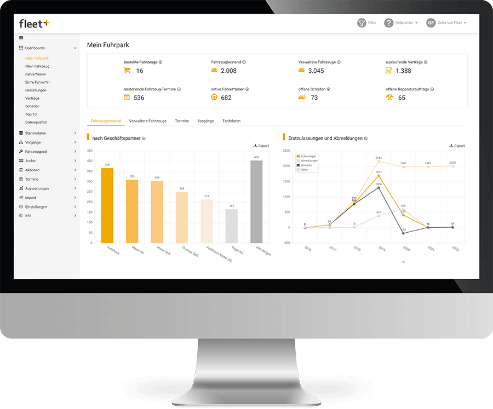
Fleet management software such as Carano Fleet+ therefore consolidates all relevant information in one central location—from vehicle and driver data to lease agreements, costs, schedules, and operator obligations. Among other things, it supports companies with master data management, driver’s license checks, accident prevention documentation, claims management, and reporting and analysis tasks.
For small and medium-sized businesses in particular, a centralized database is crucial for transparently managing mobility costs, automating processes, and making informed decisions. With this foundation, key metrics can be continuously monitored, including:
- Total Cost of Ownership (TCO)
- Fuel Consumption
- Maintenance Costs
- Loss ratio
- Service life
- Excess Lease Kilometers
- CO₂ emissions
Comprehensive Fleet Management: What Fleet Managers at Mid-Sized Companies Really Need
Comprehensive fleet management is essential for small and medium-sized businesses today to effectively manage efficiency, cost control, and owner liability. Fleet managers not only need to maintain an overview of vehicles and costs—they must also ensure that employees are aware of their responsibilities and that all legal requirements are reliably met.
A centralized fleet management software solution provides exactly this foundation: It consolidates all relevant information, lightens the workload for fleet managers in their day-to-day operations, and increases the efficiency of the entire fleet organization over the long term.
Electric Vehicles in Medium-Sized Company Fleets
Electric mobility is also becoming a greater priority for medium-sized fleets. Companies are increasingly integrating electric vehicles and are working to reduce CO₂ emissions and energy consumption in their fleets, as well as incorporating alternative mobility concepts.
According to a market study by the mobility service provider UTA Edenred (2025), 59% of the companies surveyed already have a fleet that is at least partially electrified.
In addition to electrifying their fleets, companies are increasingly focusing on charging infrastructure, CO₂ reporting, pooled vehicles, carsharing, and mobility budgets. A key challenge is integrating new vehicles and mobility options effectively into existing processes and structures.
The Key Success Factors at a Glance
- Clear Responsibilities
- Standardized Processes
- Transparent Key Performance Indicators
- Modern Fleet Management Software
- Strategic Service Provider Management
Efficiency as a Key Competitive Advantage
For small and medium-sized businesses, the efficiency of fleet management often determines how competitive a company remains. Comprehensive, digital fleet management is not just a “nice-to-have”—it is an essential component of a future-proof business organization. Fleet managers who consistently standardize processes, transparently control costs, and reliably fulfill vehicle owner liability obligations significantly reduce the workload for both employees and management alike.
The efficiency of modern fleet management is evident in three key areas:
- Cost Transparency – Keep Track of TCO, Fuel Consumption, and Maintenance Costs at All Times
- Process Automation —From Deadline Tracking to Digital Documentation
- Legal Certainty – Reliably Meeting Requirements for Vehicle Owner Liability, Driver’s License Checks, and UVV Training
Those who lay this foundation will ensure their fleet is ready to meet today’s demands—and tomorrow’s challenges.
How to Succeed at Modern Fleet Management in Small and Medium-Sized Businesses
Fleet management in small and medium-sized businesses today goes far beyond mere vehicle administration. Cost control, compliance, digitalization, and climate and environmental goals are increasingly turning the fleet into a strategic business function.
At the same time, many companies face similar challenges: a lack of transparency, manual processes, unclear responsibilities, or an inadequate data foundation often lead to avoidable effort and unnecessary costs.
Successful companies address these challenges with clearly defined responsibilities, standardized processes, and the consistent digitization of their fleet management. High-performance fleet management software like Carano Fleet+ provides the necessary transparency, helps ensure compliance with legal requirements, and delivers the data needed to make informed decisions.
Conclusion: Fleet Management for Medium-Sized Companies
- Professional fleet management helps small and medium-sized businesses control costs, comply with legal requirements, and reduce administrative burdens in the long term.
- Small and medium-sized businesses that systematically analyze their fleet data and actively refine their mobility strategy create transparency and ensure their competitiveness.
- Striking the right balance between internal management and external service providers helps small and medium-sized businesses use their resources efficiently and reduce administrative burdens.
FAQ – Fleet Management for Small and Medium-Sized Businesses
Generally speaking, companies with as few as 10 to 15 vehicles can already benefit from a digital solution. Once a fleet reaches this size, manually managing maintenance appointments, driver’s license checks, and costs quickly becomes overwhelming. The sooner companies adopt centralized fleet management software, the easier it is to scale their fleet.
Fleet managers at medium-sized companies often have a broader range of responsibilities—from day-to-day vehicle management to strategic cost control—while working with more limited resources. While large corporations frequently rely on specialized teams and external service providers, medium-sized companies must handle many tasks internally and efficiently. Comprehensive fleet management software provides the necessary balance here.
Transparent TCO analyses, early maintenance planning, and optimized leasing strategies can significantly reduce fleet costs for small and medium-sized businesses. In addition, savings result from reduced manual administrative work and the avoidance of liability risks through comprehensive documentation.
Successful digital transformation projects begin with an assessment of existing processes: Where do data silos occur today? Which tasks take the most time? Based on this, fleet management software can be implemented in a targeted manner—step by step, without disrupting day-to-day operations. Solutions like Carano Fleet+ support companies throughout this process, from analysis to implementation.
Modern fleet management provides the data needed to make informed sustainability decisions: CO₂ emissions, fuel consumption, and vehicle usage can be analyzed centrally and optimized in a targeted manner. At the same time, digital fleet management software makes it easier to integrate electric vehicles and alternative mobility concepts into existing processes.
Other useful articles
- Claims management: How to handle damage to your fleet professionally
- The 5 advantages of fleet management software for your company
- Fleet management tasks: The 10 most important fleet activities
- Fleet Management: Modern vehicle management for maximum fleet efficiency
- Excel fleet management: a practical start or an outdated concept?
- Fleet management: How to manage your fleet successfully