Contract changes and exit processes, without detours and without calculation errors
Recalculation & Termination
Lease contracts change. LeaseWise moves with them
Driver changes, mileage deviations, revised car policies. In day-to-day lease practice, contract modification is the norm, not the exception. LeaseWise processes revisions retroactively or from a future date. Revision and termination can be combined in a single action.
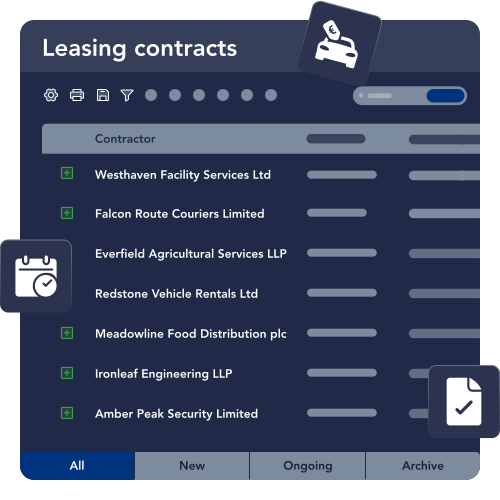
Proactive adjustment, not reactive correction
- KilometerToCheck flags deviations per contract and driver in real time, without separate email flows
- Contract revisions are created directly from the mileage overview
- Upon termination, LeaseWise automatically recalculates based on actual duration and kilometres
- Outstanding costs (fines, damage, fuel) are settled at closure
- Pre-invoiced instalments are credited from the return date
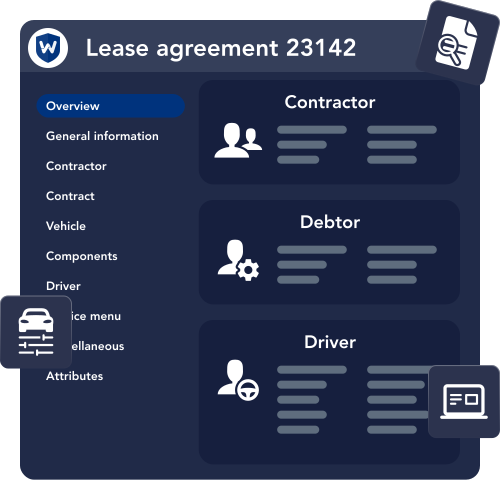
From return to sale in one flow
Once a contract ends, the remarketing process starts directly from LeaseWise.
Valuation via Autotelex at licence plate level, lot formation, online listing via external auction platforms and automatic feedback of sales results for invoicing.
The driver app informs the lease driver well before expiry about follow-up options, ensuring the first shopping moment takes place with their own leasing company — not with a competitor.
Modules & connection

KilometerToCheck

Autotelex

Remarketing-Modul API

Driver app

Once a contract has ended, the remarketing process can be initiated directly from LeaseWise. Vehicles can be valued through integrated solutions, grouped for remarketing and transferred to external auction platforms. Sales results can then be fed back into the process for further financial settlement.
How excess mileage is handled at the end of a leasing contract depends on the agreed contractual terms. In LeaseWise, actual mileage readings can be compared with the contractually agreed mileage and taken into account during the final recalculation. Any identified deviations can then be included in the final settlement.
Leasing contracts are generally concluded for a fixed term, meaning that ordinary early termination is usually not permitted. It is important to distinguish this from extraordinary termination, which may be possible for good cause, such as significant payment arrears by the lessee, a total loss or theft of the leased asset. Alternatively, the lessor and lessee may mutually agree to terminate the contract early.
In leasing, every early termination results in a final settlement. LeaseWise recalculates the contract based on the actual contract duration and mileage.
Yes. Contract revisions in LeaseWise can be applied both retroactively and with effect from a future date. This allows leasing companies to specify when a change should take effect within the contract term.
A recalculation may be necessary when key contract parameters change during the contract term. Common reasons include deviations in mileage, changes to the contract duration or other adjustments that affect the agreed terms and conditions. LeaseWise manages these changes through contract revisions.
When a leasing contract ends, LeaseWise takes the actual contract duration and mileage into account and performs a final recalculation of the relevant contract values. Outstanding items and costs, such as damage claims, fuel transactions or traffic fines, as well as adjustments to leasing payments already invoiced in advance, can be included in the final settlement.
What happens to the vehicle afterwards depends on the leasing company’s business model and specific processes. For example, the vehicle may be remarketed, retained for a contract extension, assigned to another customer or used in a rental fleet or as a replacement vehicle.
For remarketing, LeaseWise supports integrations with various sales and auction platforms, including Autotelex, BCA and CarCollect. Vehicle data, valuation information and sales details can be exchanged with these connected platforms.
With the KilometerToCheck module, current mileage data can be compared with the agreed mileage limits of a leasing contract. Relevant deviations are displayed for each contract and driver, allowing leasing companies to assess at an early stage whether a contract adjustment or recalculation is appropriate. Mileage readings are retrieved in real time via OEM data, CAN bus or GPS.