
Many companies are looking for ways to improve their employees’ mobility while reducing costs. For fleet managers, corporate carsharing can be a suitable solution for balancing these goals.
According to the Arval Fleet Barometer 2024, 23 percent of the companies surveyed are already using corporate car-sharing solutions or at least plan to introduce them within the next three years.
In this article, we’ll show how corporate carsharing can make fleet management more efficient and what benefits it can offer, particularly in terms of costs, flexibility, and vehicle utilization.
What is corporate car sharing?
Corporate carsharing is the internal sharing of company cars within a fleet. The available vehicles are no longer assigned to specific individuals but are made available to multiple employees and can be used flexibly as needed. In many companies, vehicle pooling has already become established as an alternative to rental cars or purchasing a personal vehicle.
What types of corporate car sharing are there?
Which model a company chooses depends on many factors. These include, for example, the organization of the company or the number of locations. Corporate car sharing can be organized in two different ways:
- Station-based car sharing, where the vehicles are only available for use at a specific point and must be returned to this point after the journey.
- As a free-floating model that allows vehicles to be borrowed and used in a specific area or at different company locations.

Car Sharing in the Fleet
Corporate carsharing can help companies reduce fleet costs and make more efficient use of their existing vehicles. Especially in companies where employees rarely or irregularly rely on company vehicles, shared vehicles can be used to increase fleet utilization and improve efficiency.
Even vehicles used primarily for short trips are suitable for carsharing. However, if a company mainly uses specialized vehicles that require specific driver qualifications, company vehicle sharing is only feasible to a limited extent.
Corporate car sharing can also be an interim mobility solution for fleets . Interim mobility solutions are used in fleet management to bridge vehicle bottlenecks that arise during maintenance work or when switching to a new vehicle fleet. According to the DAT Barometer 2024, 86% of fleet managers surveyed already use car sharing solutions to ensure employee mobility in the event of short-term bottlenecks.

Advantages of corporate car sharing at a glance
Company car sharing offers businesses a flexible way to use vehicles more efficiently and realize cost savings. The following four benefits illustrate how companies can benefit from a vehicle pooling concept and organize their fleet to meet their needs.
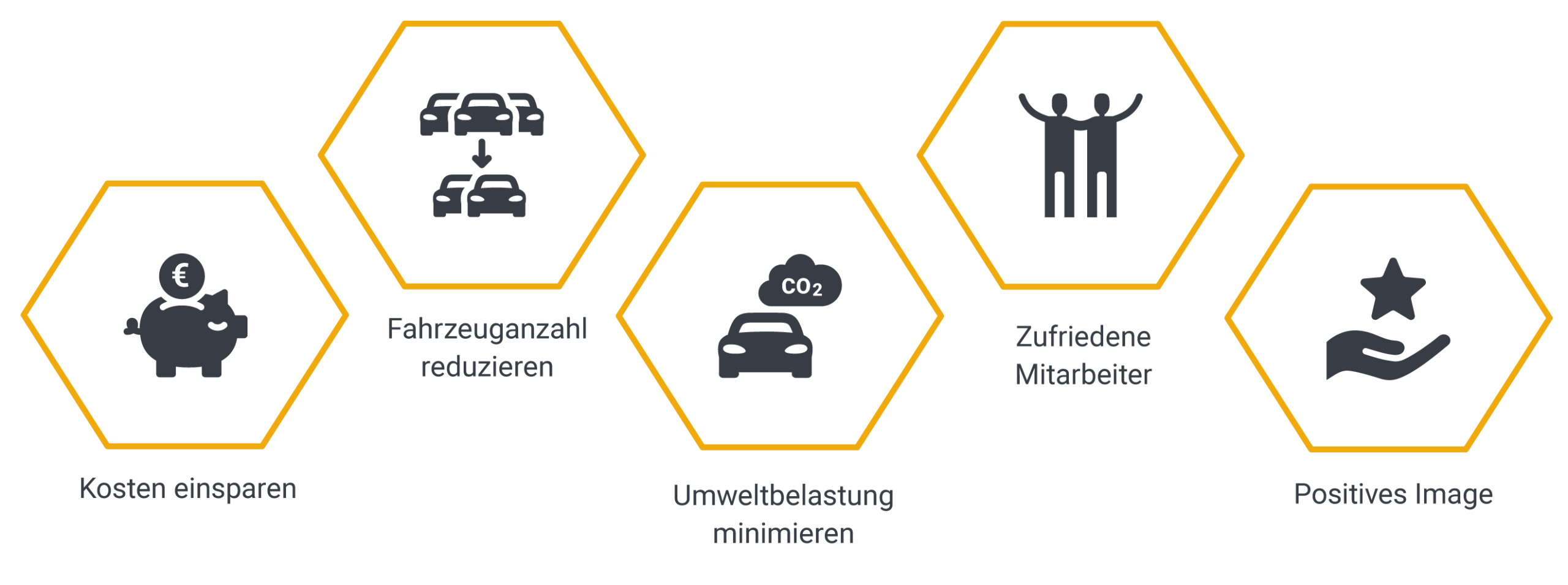
1. cost savings due to fewer vehicles in the fleet
Procuring new vehicles can cause problems. Long delivery times, a lack of choice and rising prices make the work of fleet managers extremely difficult. In many cases, however, there is no need to keep adding new vehicles. Most fleet vehicles are not used permanently and spend most of their time parked on company premises. This reduces vehicle usage and leads to lower mileage. Company vehicle sharing helps to better utilize the vehicle fleet by allowing different employees to use a vehicle as required. In many cases, this can reduce the actual number of vehicles available in the fleet.
With fewer vehicles in the fleet, companies have significantly lower expenses in the areas of vehicle purchase, maintenance, servicing and insurance. A sharing solution is often cheaper to administer than the classic company car concept.
2. More Efficient Use of Vehicles and Resources
Corporate carsharing can help make better use of existing vehicles and reduce the need for new ones. Through shared use, pooled vehicles are available to multiple employees, which can reduce downtime. Depending on mobility needs, a smaller fleet may therefore be sufficient.
A smaller vehicle fleet can also reduce costs and resource consumption, thereby supporting the fleet’s economic, climate, and environmental goals.
3. increase in employee satisfaction
Employees who use a company car often enjoy a higher degree of flexible mobility, which can have a positive impact on employee satisfaction. Until now, having their own company car has been an important incentive for many employees. After all, a new vehicle is considered a status symbol in many circles.
However, younger companies in particular are now increasingly focusing on corporate mobility that involves as many employees as possible. This new flexibility is reflected in the increased use of electric vehicles, electric bicycles, electric scooters and corporate car sharing. In this context, employees who are not provided with a company car can also benefit from the flexible mobility solution. This increases the satisfaction of more and more employees.
4. enhancement of the company image
Company vehicle sharing can be an effective way to enhance a company’s image. This is because it demonstrates that companies care about their employees’ needs and are adopting new, innovative approaches to make corporate mobility more efficient. By making more efficient use of existing vehicles and resources, companies can demonstrate that they are organizing their corporate mobility in a way that meets current needs and is future-oriented.

Organize pool vehicles: Outlook calendar vs. car sharing software
An Outlook calendar can be a simple and cost-effective way to manage company car bookings. However, fleet managers quickly reach their limits when using Outlook. It is not possible to create detailed evaluations, the overview of the fleet is limited and this approach is also problematic in terms of data protection.
To make the most of the benefits of corporate car sharing, an efficient and new approach is crucial. Car sharing software facilitates the management and booking of pool vehicles and ensures greater transparency. A variety of functions, such as the automation of reservation and booking processes or evaluations to optimize the use of vehicles, can be very valuable for fleet managers. A comparison of an Outlook calendar with professional car sharing software shows that the latter offers a number of advantages for effective fleet management.
In contrast to a simple Outlook calendar, professional car sharing software offers a more efficient and comprehensive way to manage and organize corporate car sharing in your own fleet.
The software enables companies to make better use of their resources and save costs, while at the same time ensuring greater transparency in the fleet.
FAQ – Corporate Carsharing
Corporate car-sharing software enables the efficient management and reservation of vehicles within a company, allowing different employees to use them as needed. This makes vehicle management structured and straightforward—for both fleet managers and employees.
The private use of pool vehicles is permitted if it is regulated in a usage agreement. Often, certain conditions or restrictions apply, such as fixed times or additional requirements. In addition, private use must generally be correctly recorded in the logbook in order to make the separation between business and private journeys traceable.
It reduces the need for companies to purchase a large number of vehicles, as the vehicles are used as required. This lowers the costs for acquisition, maintenance, servicing and insurance.
Company car sharing is a solution in which employees of a company use vehicles flexibly and jointly for business purposes. A car subscription, on the other hand, offers individuals or companies an exclusive vehicle for a monthly flat rate, including all ancillary costs.
Companies can either use their own vehicles or rent them from providers. The corporate car sharing provider makes the vehicles available so that no investment in the company’s own fleet is necessary. This solution is particularly advantageous for smaller companies.
More useful articles on the topic of corporate car sharing
- Pool vehicle management: advantages, organization and taxation of pool vehicles in the fleet
- The advantages of pool vehicle software for the vehicle fleet
- Company car costs for employers: everything you need to know
- Vehicle management: efficient processes for a modern vehicle fleet
- Fleet Management: Modern vehicle management for maximum fleet efficiency