In an increasingly digitized business world, fleet management is becoming increasingly important. Companies with their own vehicle fleets now face complex challenges: rising operating costs, legal requirements, and growing demands for efficiency, electrification, and the reduction of energy consumption and CO₂ emissions.
Only through centralized, digital management can these challenges be met. This is precisely where modern fleet management comes into play—as a strategic interface between vehicles, drivers, data, and digital systems.
Contents
- 1. What is Fleet Management?
- 2. Why is digital fleet management indispensable today?
- 3. Data protection & GDPR: Data security in digital fleet management
- 4. People at the center: drivers and those responsible
- 5. Best practices: What makes for successful fleet management
- 6. Cost Reduction, Compliance, and CO₂ Reduction: The Key Objectives
- 7. For whom is fleet management worthwhile?
- 8. Fleet management for e-vehicles: challenges and opportunities
- 9. Looking to the future: developments in fleet management
What is Fleet Management?
Fleet management, also known as vehicle fleet management, covers the entire organization, monitoring and optimization of all processes relating to a company’s vehicle fleet. This includes
- Procurement and decommissioning of vehicles
- Maintenance, repair and claims management
- Driver management and driver’s license control
- Cost control and contract management
- Compliance with legal regulations
- Planning and evaluation of trips
- Integration of modern telematics systems
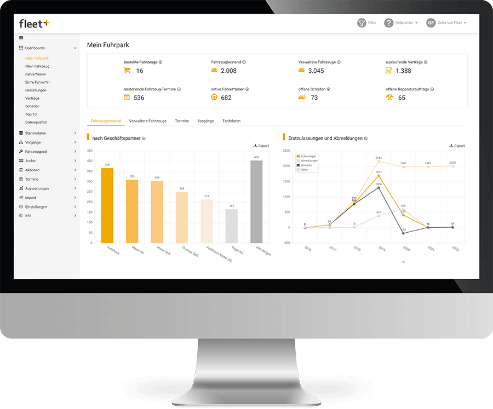
A digital fleet management system combines these tasks into a single, centralized platform that connects all stakeholders, automates processes, and provides meaningful insights into fleet usage.
In addition, modern systems provide automatic reminders for maintenance appointments, seamless communication with drivers, and integration with other business solutions such as ERP or accounting systems. This comprehensive integration provides a holistic overview of the fleet—including costs, utilization, CO₂ emissions, and potential areas for optimization. As a result, fleet management becomes not only more efficient but also strategically controllable.
Why is digital fleet management indispensable today?
Traditional methods such as Excel lists or paper-based logbooks quickly reach their limits in modern fleet management. They offer neither the necessary transparency nor the efficiency or legal certainty that are required in day-to-day business today. Instead, more and more companies are turning to digital solutions that bundle all data relating to vehicles, drivers and processes and make it available on a central platform.
A modern fleet management system makes it possible to digitally manage contracts, vehicle data, and driver profiles, and to automatically monitor maintenance cycles, lease terms, and vehicle inspection appointments. Electronic logbooks can also be seamlessly integrated, which significantly simplifies the documentation of all vehicle-related processes.
In addition, the integration of telematics systems enables precise monitoring of driving behavior and fuel consumption—key factors for safety and cost-effectiveness. Intelligent route planning further helps to increase productivity and allocate resources more effectively.
Especially for larger fleets or decentrally organized locations, this form of central control proves to be a decisive advantage. It ensures clear structures, better planning and significantly reduces the administrative workload – an important step towards sustainable fleet management.
Data protection & GDPR: Data security in digital fleet management
In addition to efficiency gains, the increasing digitalization of fleet management also brings with it new data protection requirements. Modern fleet management systems process sensitive data – such as driver data, driving behavior, locations and contract information. Companies are therefore obliged to ensure data security in accordance with the General Data Protection Regulation (GDPR).
A professional fleet management system offers clear advantages in this regard:
- Automatic Retention Periods and Archiving
- Role-based user rights to prevent unauthorized access
- Relevant data protection features such as audit trails or logging
- Secure cloud or on-premises storage to the highest standards
Those who opt for a solution that complies with data protection regulations not only protect personal data but also ensure the trust of drivers, partners, and government agencies.
People at the center: drivers and those responsible
As important as digital processes are, in the end, it’s the people who matter. Well-organized fleet management not only takes the pressure off the fleet managerbut also the drivers. They benefit from clear processes, easy communication, and intuitive digital solutions—such as apps or driver portals.
At the same time, the demands on management are increasing: changes in legislation, tax regulations, CO₂ reporting, and safety requirements call for regular professional development, strategic thinking, and data-driven decisions. Modern systems provide the transparency needed to take responsibility for the fleet .
Best practices: What makes for successful fleet management
Successful fleet management involves much more than just vehicle administration. Companies that take a strategic approach to fleet management and make comprehensive use of digital solutions reap measurable long-term benefits.
Practical examples show this:
- Savings on maintenance costs through automatic reminders and targeted planning
- Reducing downtime through preventive measures
- Faster response times in the event of damage thanks to digital documentation
- Better Decision-Making Through Relevant Analyses and Reports
What is important here is that the introduction of a fleet management system should be considered holistically from the outset – with a focus on processes, training and interfaces to existing IT systems. In this way, fleet management becomes a real success factor in the company.
Cost Reduction, Compliance, and CO₂ Reduction: The Key Objectives
Professional fleet management pursues three central objectives:
- Reduce costs through efficient processes, fewer breakdowns, more favorable contracts and reduced downtimes
- Legal certainty through comprehensive documentation and automated compliance monitoring
- Take climate and environmental goals into account by integrating e-mobility, promoting efficient vehicle use, and transparently tracking energy consumption and CO₂ emissions
Tracking CO₂ emissions in vehicle fleets is becoming increasingly important. Companies can transparently analyze this data, track trends, and use the insights to develop measures for reducing CO₂ emissions. At the same time, they create an important data foundation for regulatory reporting requirements.
A holistic fleet management system is far more than just an administration tool – it is an effective instrument for organizing mobility in an economical, compliant and responsible manner.
For whom is fleet management worthwhile?
The question today is not so much whether, but how a company implements fleet management. Even small fleets with ten or more vehicles benefit significantly – be it through less effort, lower error rates or better vehicle utilization.
Fleet management is particularly worthwhile for:
- Medium-sized companies in trade or field service
- Large companies with branches in Germany and abroad
- Service providers with high vehicle rotation (e.g. logistics, delivery)
- Leasing companies and car rental companies
- Public bodies, municipalities and social institutions
The more automated and digital the processes, the greater the added value – regardless of the size of the fleet.
Fleet management for e-vehicles: challenges and opportunities
As the shift toward electric mobility continues, fleet management is also undergoing fundamental changes. The use of electric vehicles brings new demands on processes and systems—whether in planning charging infrastructure, optimizing range, or managing subsidies. Modern fleet management systems offer practical solutions for these challenges by, for example, intelligently scheduling charging times and automatically integrating charging cycles into the schedule. At the same time, they enable real-time monitoring of battery status and energy consumption, which not only increases reliability but also makes route planning more efficient.
The optimization of driving profiles and routes, taking vehicle range into account, is also increasingly being handled automatically. In addition, environmental metrics can be precisely analyzed—for example, for ESG reporting or when applying for grants.
The comprehensive digitization of the fleet provides an important foundation for analyzing and managing vehicle usage, energy and fuel consumption, and CO₂ emissions in a targeted manner. This also applies to mixed fleets consisting of internal combustion engine vehicles and electric vehicles. Companies that adopt the right systems early on not only manage the transformation efficiently but also gain a clear competitive advantage.
Looking to the future: developments in fleet management
The future of fleet management is data-driven, automated and networked. The following developments are already emerging:
- Artificial intelligence for predictive maintenance (e.g. detecting impending failures)
- Intelligent driver assistance systems to increase safety
- CO₂ Monitoring and Energy and Consumption Metrics
- Cloud-based systems for mobile working in fleet management
- Cross-platform connection of telematics, fuel cards, leasing data and much more.
Developments in fleet management clearly show that digitizing and automating processes today lays the groundwork for efficiency, cost reduction, and regulatory compliance. Software solutions make fleet management future-proof—both for traditional fleets and for the adoption of e-mobility. Companies that embrace these key innovations early on not only benefit operationally but also position themselves strategically as pioneers in their industry.
FAQ – Frequently asked questions about Fleet Management
Fleet management refers to the digital management and optimization of all processes relating to a company’s vehicle fleet – from procurement to decommissioning.
Automation, AI-supported maintenance forecasts, CO₂ tracking and integrated telematics solutions will be crucial in the future.
Typical tasks include vehicle management, driver management, maintenance planning, cost control, damage documentation and compliance with legal regulations.
For all companies with several vehicles – especially in field service, logistics or the service sector.
Fleet management reduces costs, increases transparency, ensures compliance and enables sustainable use of the fleet.
Conclusion on fleet management
- Digital fleet management significantly simplifies vehicle fleet management. Automated processes and centralized systems ensure greater efficiency, transparency and lower administrative costs.
- Companies benefit from lower costs and better use of resources. Maintenance, driving behavior, contracts and CO₂ values can be controlled and evaluated in a targeted manner.
- Modern solutions meet current data protection and compliance requirements. Data security, GDPR compliance and legally compliant documentation are integrated.
Other useful articles on the subject of fleet management
- Fleet management software: an end to manual processes and data loss
- Fleet insurance: cover for your vehicle fleet
- The 5 advantages of fleet management software for your company
- Fleet management tasks: The 10 most important fleet activities
- Setting up a fleet organization: structure, processes and digital solutions