
The mobility budget offers companies the opportunity to make corporate mobility more flexible and tailored to individual needs. According to the Arval Mobility Observatory 2023, 21 percent of German companies were already using a mobility budget at that time. Especially in hybrid work models, this allows employees to use different modes of transportation to suit their individual needs.
But can a mobility budget help increase flexibility in workplace mobility? In this article, you’ll learn what a mobility budget for employees is, how it works, and what benefits it offers to companies and employees.
What is a mobility budget?
The employee mobility budget is an alternative to a company car. The employer provides a predetermined budget that can be used flexibly for various modes of transportation. The mobility budget can then be allocated as desired throughout the month for both business and personal trips across various modes of transportation, such as public transit, Deutsche Bahn, car-sharing, rental bikes, e-scooters, electric scooters, taxis, etc. This concept offers greater flexibility in choosing the most suitable mode of transportation and can be integrated into an existing fleet.
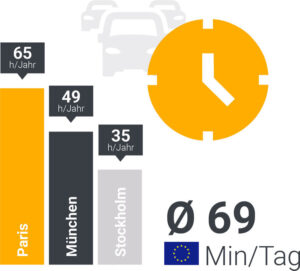
If the allowance for work-related and personal travel is not fully used up during the current month, the remaining balance can usually be used for other purposes or benefits. For example, it can be used to buy a new bicycle or as a contribution to a retirement savings plan. Employees who are particularly frugal—such as those who use public transit or the train—are then rewarded even further. Furthermore, a mobility budget gives employees an incentive to leave the company car at home more often—especially in congested metropolitan areas, where they want to avoid traffic jams and the hassle of finding a parking spot.
Benefits of a Mobility Budget
The idea behind the mobility budget is to give employees maximum flexibility in choosing their mode of transportation. Ideally, they will opt for environmentally friendly alternatives such as public transportation or the train. Sooner or later, company cars assigned to specific employees will lose their appeal. For fleet management, a mobility budget means more efficient and cost-effective management of the vehicle fleet.
But a mobility budget has even more advantages:
For Employees:
- Incentives to Use Alternative Mobility Options
- No need to search for parking and fewer traffic jams, especially in urban areas
- Greater Flexibility in Mobility
- Increasing Satisfaction
For Employers:
- Greater Inclusion in the Workplace
- Better Cost Control Through Fixed Budgets
- Improving the company’s image and differentiating itself from the competition
- Promoting lower-emission forms of transportation

A mobility budget instead of a company car?
According to a study by SAP Concur, 57% of employees who live in the city would like to have a mobility budget. Among employees in rural areas, the figure is still 40%.
Even as companies become more willing to organize employee mobility in a flexible manner, it is important that they first carefully assess the individual needs and preferences of their employees as well as their operational requirements.
Mobility budgets are particularly popular in urban areas, where there is a wide selection of e-bikes and car-sharing providers, and the local and long-distance transit networks are very well developed. In rural areas, the situation is often different. Here, the majority of employees still rely on a company car for both work and personal trips. Field staff who regularly have to attend client and business meetings also want to be able to get around easily. Some industries, such as skilled trades or care services, also rely on their own vehicles to transport tools, machinery, and equipment.
Therefore, in some cases, a mobility budget for employees is not a substitute for the company car model, but rather a complement to the mobility mix. For many employees, simply having the choice between the two options already contributes to greater satisfaction.
Taxation of Mobility Budgets: Consider Legal Aspects
Anyone considering a mobility budget for employees as an alternative or supplement to the traditional company car should familiarize themselves with the tax and labor law implications in advance. The tax regulations governing the calculation of the monetary benefit for personal use of company vehicles are clearly defined by law.
Different rules may apply to the taxation of mobility budgets depending on the type of mobility, and costs for taxes and social security contributions may apply. With mobility budgets, the type and amount of the budget also play a role and can result in more favorable tax treatment.
It is important to note that budget expenditures must be recorded, accounted for, and allocated to individual employees on a “user-pays” basis. This can be easily done using software or an app from specialized providers. When implementing a mobility budget for employees, fleet management should always seek legal and tax advice.
Employee Mobility Budget: Steps to Consider
Implementing a mobility budget within a company requires not only careful planning but also the commitment of everyone involved —from management to the human resources and finance departments, right down to the employees themselves.
- Objective:The company should set clear goals for its mobility budget, such as better cost control, greater flexibility, or a reduction in itscarbon footprint.
- Budget Definition: Fleet management must set a budget that employees can use to finance their new mobility solutions. In doing so, they should take into account the previous costs associated with company cars.
- Informing and Training Employees: It is important to inform employees about the change and explain how the new mobility budget works. Training sessions or informational meetings can be helpful in this regard.
- Offer a wide range of mobility solutions: The company should provide employees with a wide range of mobility solutions that fit within the budget, such as public transportation, car-sharing, bicycles, or e-bikes.
- Monitoring and Adjustment: The company should regularly monitor the mobility budget and adjust it as needed to ensure that it meets employees’ needs and achieves its goals. It may be helpful to first test the concept with a smaller pilot group and make adjustments.
- Incentives for alternative modes of transportation: Companies can provide additional funding for employees who, for example, use public transportation or bicycles. This allows them to specifically encourage the use of various modes of transportation.