
Whether you are a growing SME or an established corporation – as soon as several company vehicles are in use, clear rules are needed. This is exactly where the car policy comes in: it ensures transparency, safety and smooth processes in the vehicle fleet. But what exactly is behind it?
A car policy is an important tool in a company’s fleet that governs the use of company cars. Whether it involves choosing a company car, personal use, or dealing with an accident, a well-thought-out company car policy provides clarity and helps prevent misunderstandings. It is therefore much more than just an internal document; it serves as an important foundation for consistent and needs-based vehicle use within the company. In this article, you’ll learn what a car policy is and why it makes sense for your fleet.
Contents
- 1. Definition: What is a car policy?
- 2. Mandatory contents of a company car policy
- 3. Download free car policy template
- 4. Importance of a company car policy in the vehicle fleet
- 5. For whom is a car policy particularly important?
- 6. Advantages of a company car policy in the fleet
- 7. Car policy and electromobility
- 8. Challenges when introducing a car policy
Definition: What is a car policy?
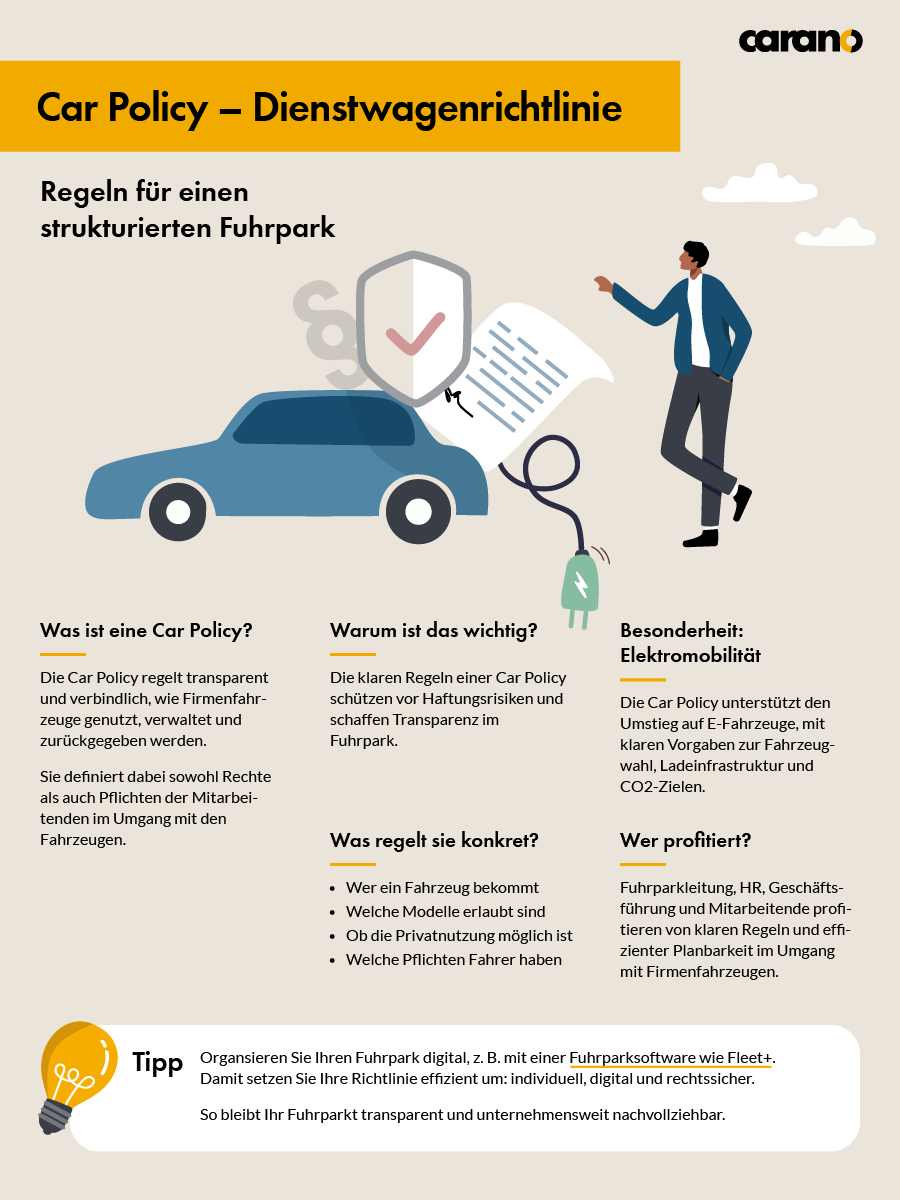
A car policy is a binding, internal company regulation that defines the deployment, use and management of company vehicles. It defines who is entitled to a company vehicle and under what conditions, how the vehicle is selected, what types of use are permitted (e.g. private journeys) and what rules apply in the event of damage, maintenance or return.
Such a company car policy also defines the rights and obligations associated with the use of the company car, the vehicle classes available for selection and the corresponding conditions.
In addition, the car policy can be managed directly in fleet management software to facilitate the implementation of the guidelines.
Mandatory contents of a company car policy
A professional car policy should contain more than just basic regulations. It forms the foundation for legal certainty, efficiency and transparency in dealing with company vehicles. The following content should be included in every company car policy:
- Entitlement regulations: Who is entitled to a company car and under what conditions?
- Vehicle selection and equipment: Which classes and brands are permitted? Which optional extras are permitted or excluded?
- Private use: Are private journeys permitted? Is there a mileage limit?
- Driver obligations: e.g. driving license checks, UVV instructions, reporting damage
- Claims and return processes: What is the procedure for accidents? What applies to leasing returns?
- Tax regulations: 1% rule, logbook, non-cash benefit
- E-Mobility and CO₂ Emissions: Guidelines for Vehicle Selection, CO₂ Limits, and Charging Infrastructure
- Violations: What are the consequences of disregarding the rules?
A well-structured car policy not only creates safety for companies and drivers, but also helps to optimize processes and control costs.
Download free car policy template
Importance of a company car policy in the vehicle fleet
In fleet management, a car policy serves as a binding framework for the use of company vehicles. It defines processes, responsibilities and requirements relating to the procurement, use and return of company cars. It thus forms the basis for uniform and legally compliant fleet management.
A well-thought-out company car policy takes into account both the needs of the company and the wishes and requirements of employees eligible for company cars. It forms the foundation for effective fleet management that prioritizes employee safety and satisfaction.
The company car directive should not be confused with a company car transfer agreement: This implements the requirements at an individual level. It is concluded between the employer and employee and regulates the specific provision of a particular vehicle. It usually refers to the car policy and makes its contents binding for the respective company car user.

For whom is a car policy particularly important?
A car policy is not only aimed at company car users, but is also a central control instrument for various departments in the company. It ensures that everyone involved acts in accordance with clear guidelines – from the selection to the return of the vehicle.
The Car Policy is particularly relevant for:
- Fleet managers who need to keep track of vehicle use, safety and maintenance and avoid liability risks.
- Management and controlling, who keep an eye on the profitability of the vehicle fleet and plan budgets with clear regulations.
- HR departments that use company cars as part of remuneration models and are dependent on a legally secure framework when drafting contracts.
- Managers responsible for climate and environmental goals who want to implement CO₂ targets, funding opportunities, and alternative propulsion systems within the company.
Advantages of a company car policy in the fleet
A car policy establishes clear rules for the use of company vehicles and ensures greater transparency, legal certainty, and efficiency within the fleet. It helps companies control costs, reduce liability risks, and incorporate climate and environmental goals into their fleet management.
The most important advantages at a glance:
1. Consistent Standards and Fairness
A car policy ensures that all employees are equally informed about the rules and obligations regarding the use of company vehicles. This creates a solid foundation that avoids misunderstandings and provides a level playing field for all employees.
A company car policy regulates, for example, who is entitled to a company car and under what conditions, and how the vehicles may be used. This also includes rules for private use or mileage limits.
It also defines what responsibilities employees have, including maintenance, reporting damage and compliance with safety regulations.
2. Improved Safety in the Fleet
A car policy helps to increase safety in the fleet. It defines binding safety standards as early as the vehicle selection and configuration stage and sets out the requirements for drivers and vehicles.
As company vehicles are subject to § 2 of the Industrial Safety Ordinance are considered work equipment, companies must comply with occupational health and safety regulations and accident prevention regulations. A documented company car policy helps to implement legal requirements, reduce liability risks and promote employee safety.
The most important safety aspects of a car policy include
- Selection of vehicles with high safety standards, for example a 5-star rating in Euro NCAP crash tests
- Regulations for safe vehicle use, for example through UVV driver instructions and guidelines on breaks or driving times
- Definition of required safety and assistance systems such as hands-free system, navigation system, head-up displays or driver assistance functions

3. Take climate and environmental goals into account
A company car policy can be used to specifically promote the use of vehicles with lower CO₂ emissions, electric vehicles, or hybrid models. It can also set forth requirements regarding CO₂ emissions and fuel consumption that must be taken into account when selecting new company vehicles.
This enables companies to define specific criteria for vehicle selection and to take CO₂ emissions and fuel consumption within their fleet into account. In addition, incentive programs can motivate employees to adopt fuel-efficient driving habits.
4. Cost Control Through Company Car Policies
By limiting the vehicle models and brands that can be selected in the vehicle configuration, volume discounts and lower costs for maintenance and spare parts can be achieved. A narrower selection can also simplify administration and limiting optional extras can increase the resale value of vehicles.
The use of fuel-efficient or alternatively powered vehicles can be defined in a car policy in order to achieve savings in fuel costs. The introduction of usage limits or restrictions on private use also contribute to better economic efficiency.
Car policy and electromobility
As fleets become increasingly electrified, the car policy is becoming even more important. It helps companies strategically manage the integration of electric vehicles and set specific goals for electrification and reducing emissions in their fleets.
These may include, for example, quotas for electric vehicles, deadlines for reducing CO₂ emissions in the fleet, and guidelines for vehicle selection based on range, emissions, or total cost of ownership (TCO).
In addition, the company car policy may include provisions regarding charging infrastructure, reimbursement for charging costs, and the use of electric and hybrid vehicles. In this way, it lays the groundwork for the cost-effective and needs-based integration of e-mobility into the fleet.
Challenges when introducing a car policy
The introduction of a car policy is an important step towards structured and legally compliant fleet management. In practice, however, it often turns out that a well-intentioned set of rules alone is not enough. Companies face various challenges that need to be taken into account when creating and implementing them:
1. Complexity and comprehensibility
Many car policies are formulated too extensively or too technically, making them difficult for employees to understand. Comprehensible language, a clear structure and examples from everyday life are crucial for the policy to be accepted and actually applied.
2. Coordination with various departments
The car policy not only affects the vehicle fleet, but also HR, controlling, purchasing and the works council. Conflicts often arise if interests are not coordinated in good time. An interdisciplinary approach from the outset ensures broad acceptance within the company.
3. Topicality and maintenance
Once set up and never revised again? This is a common mistake. But market conditions, tax regulations and technical developments change quickly. A good car policy must therefore be regularly reviewed and adapted in order to remain effective in the long term.
4. Technical implementation
For larger fleets in particular, the question arises as to how the guidelines can be implemented efficiently. Without digital support from fleet software or a vehicle configurator such as Easy+, it quickly becomes confusing. Technical mapping is therefore a key success factor.
Conclusion: Why is a car policy indispensable today?
- A car policy provides binding rules, creates transparency for all parties involved and minimizes liability risks through clearly defined rights, obligations and processes.
- Standardized vehicle selection, clear usage regulations and digital management allow fleet costs to be controlled, processes to be simplified and long-term planning to be secured.
- A modern car policy takes climate and environmental goals into account, regulates the use of electric and hybrid vehicles, and helps companies systematically integrate electrification and CO₂ reduction into their corporate mobility strategies.
FAQ – Car Policy
A car policy, also known as a company car policy, is an internal set of rules that governs the use, selection, management and return of company vehicles. It sets out binding rules on who is entitled to a company car, how the vehicle may be used (e.g. private use), which vehicles are available and what obligations the drivers have to fulfill. The aim is to create transparency, ensure legal certainty and enable uniform handling of the vehicle fleet.
A car policy establishes uniform rules for the use of company vehicles. It increases transparency, supports cost control, reduces liability risks, and helps companies comply with legal requirements as well as meet climate and environmental goals for their vehicle fleet.
It defines who is eligible for a company car, which models may be selected, whether personal use is permitted, and what obligations drivers must fulfill—such as regarding maintenance, driver’s license checks, or accidents. Return procedures, tax regulations, and environmental requirements—such as CO₂ emission limits—are also typical components. In this way, the car policy establishes clear, uniform standards for the entire fleet.
Every fleet should have a car policy. It defines uniform rules for handling company cars, improves safety, avoids misunderstandings and saves time and costs thanks to standardized processes – especially in smaller companies.
The car policy is a general set of rules that applies to all employees who are permitted to use a company vehicle. It describes the framework conditions and standards for vehicle selection, use, return and responsibilities within the company.
The company car transfer agreement, on the other hand, is an individual contract between the employer and an employee. It is based on the car policy and specifically regulates which vehicle is provided to a particular employee – including special equipment, conditions of use and private journeys. You could say that the car policy is the basic framework and the transfer agreement is the personal agreement.
A car policy should be introduced as soon as a company provides company vehicles. Early guidelines create clear rules and responsibilities. This ensures efficient and safe fleet management right from the start.
A car policy establishes clear rules for the use of company vehicles and is therefore a key control tool in fleet management. It reduces misunderstandings, increases legal certainty, facilitates compliance with legal requirements such as the UVV, and enables cost-effective management of the vehicle fleet. It also enables the systematic implementation of environmental and climate goals—for example, through CO₂ limits or the integration of electric vehicles.
A functional fleet is used to fulfill the main operational tasks. This includes, for example, the transportation of goods or customer services. These fleets are geared towards the specific requirements of the company.
In contrast, there is the user-chooser fleet. These are company vehicles that are part of the salary package and serve as a motivational or recruitment tool. Employees (users) can select and configure their vehicle themselves within the framework of predefined options.