 Hans-Joachim Guth
In fleet management, many tasks fall to the fleet manager. He coordinates vehicle schedules, liaises with drivers and service providers, and ensures that important information reaches the right people. But if every inquiry and every data change has to go through him, it wastes time unnecessarily.
Role-based fleet management provides a solution: Tasks and access rights are assigned in a targeted manner, while the fleet manager maintains an overview. In this article, you’ll learn how to effectively delegate responsibilities within your fleet, what benefits this brings, and how fleet management software can help you do so.
In a nutshell: With role-based fleet management, all stakeholders—such as the HR department, drivers, repair shops, or service providers—are granted exactly the access rights and tasks they need for their part of the processes. Data is maintained where it is generated, and the fleet manager retains control via centralized software. This reduces the need for coordination, improves data quality, and supports compliance with vehicle owner obligations.
Contents
- 1. Why Fleet Managers Shouldn't Handle Everything Themselves
- 2. Roles in Fleet Management: Who Takes on Which Task?
- 3. Real-World Examples: How the Division of Responsibilities Works
- 4. Delegate Tasks, Retain Responsibility
- 5. Benefits of Roles and Permissions in Fleet Management
- 6. Roles and Permissions in Carano Fleet+
- 7. Conclusion
- 8. FAQ on Role-Based Fleet Management
- 9. Other useful articles
Why Fleet Managers Shouldn’t Handle Everything Themselves
The challenges of fleet management are growing: more vehicles with different powertrains, more regulatory requirements, more service providers, and more data. If every piece of information passes through the fleet manager’s desk, he becomes a bottleneck. Instead of preparing strategic decisions on costs, procurement, or electrification, they’re busy forwarding emails and typing up data.
This is where a role-based organization comes into play. Each department and partner maintains the data for which it is responsible directly in a central software system.
The fleet manager is only involved when a decision or approval is actually required.
Roles in Fleet Management: Who Takes on Which Task?
Which roles make sense depends on the size and organization of the fleet. Typical roles include:
- Fleet Manager: manages the fleet, makes decisions regarding procurement, contracts, and costs, and monitors compliance with guidelines.
- Human Resources Department: manages employee onboarding and offboarding, maintains driver master data, and handles company car authorizations.
- Drivers: Report damage, mileage, or defects and handle tasks such as checking their driver’s licenses on their own.
- Repair Shops and Service Partners: Access damage reports and photos and document repairs to the vehicles.
- Accounting and Controlling: Review invoices and analyze costs.
- Management: receives reports on costs and key performance indicators without having to maintain data themselves.
Before reassigning tasks, companies should first determine who is responsible for which processes. What information does the HR department need? Which tasks can drivers handle on their own? And which decisions remain the responsibility of the fleet manager? Based on this, roles and access rights can be set up in the fleet management software. It is important to review these responsibilities regularly and adjust them as organizational changes occur.
Real-World Examples: How the Division of Responsibilities Works
Scenario 1: An employee leaves the company
An employee leaves the company and must return their company car. For the fleet manager, this means coordinating the return of the vehicle and the key. But who updates the driver’s information in the system?
The solution: Using fleet management software that maps out roles, the HR department updates driver information itself. The fleet department is automatically notified of the change and simply schedules the appointment for vehicle and key handover. This division of tasks improves efficiency and saves the fleet manager valuable time.
Scenario 2: A driver reports accident damage
After an accident, the driver reports the damage. Fleet management is notified, organizes the necessary assistance, and schedules an appointment with the repair shop. The repair shop needs the accident report and photos to estimate the repair costs.
The solution: The employee documents the damage digitally with photos, and the repair shop, as a service partner, is granted its own access rights to that specific case. Information no longer needs to be forwarded via email, and everyone involved is working from the same set of information. The fleet manager maintains an overview of the entire process and intervenes only when approval is required.
Scenario 3: Regular Driver’s License Checks
Companies must verify at regular intervals whether their drivers hold a valid driver’s license. If this is done manually, it is time-consuming and prone to errors.
The solution: Drivers perform the checks themselves using a smartphone app and receive automatic reminders for upcoming inspections. Fleet managers can use the software to see who has been checked and where action is needed. For more information, visit the page on electronic driver’s license checks.

Delegate Tasks, Retain Responsibility
Role-based work does not mean that duties disappear. The company remains responsible for the vehicles. While tasks such as checking driver’s licenses or providing driver training can be delegated to individuals or departments, this delegation should be clearly defined, documented, and regularly monitored.
Fleet management software with roles and permissions helps define responsibilities, document completed tasks, and keep track of upcoming deadlines. This allows employees to handle operational tasks while fleet managers monitor compliance with regulations. The same principle applies to UVV driver training.
Benefits of Roles and Permissions in Fleet Management
When employees and external service providers complete their tasks directly within a centralized fleet management software system, much of the manual coordination is eliminated. This offers several advantages:
- Higher data quality: Data on vehicles, drivers, and costs is recorded once, right where it is generated. This eliminates duplicate entries and data entry errors.
- Faster processing: Intermediate steps involving fleet management are eliminated, and information is available immediately.
- Lower process costs: less manual data entry, fewer forwardings, fewer follow-up inquiries.
- Greater transparency: Reports are available at the click of a button, and documents and images can be accessed by all authorized users.
- Better service quality: For example, employees can access the car policy themselves, while the Controlling department and management receive up-to-date reports.
Roles and Permissions in Carano Fleet+
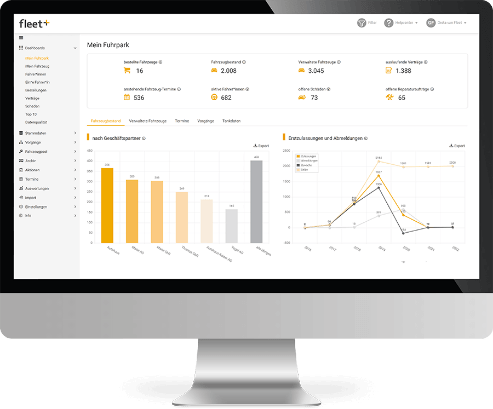
With Carano Fleet+, the CarWise Group’s fleet management software, companies can specify which employees, departments, and external service providers are authorized to access certain fleet data. For example, the HR department can maintain driver data, while the accounting department can view vehicle expenses. The fleet manager maintains an overview and decides which tasks and permissions to delegate to other stakeholders.
Automated emails with customizable templates notify the relevant parties, and a wizard guides users step by step through recurring processes. Data can be imported from HR, ERP, or financial accounting systems via interfaces—such as a standardized REST API—so that changes made by the HR department, for example, do not have to be entered twice. Carano Fleet+ is available as a SaaS solution or as an on-premises installation and can therefore be used from various locations.
Role-Based Workflow for Fleet Service Providers
For service providers who manage vehicles for multiple customers, a clear authorization structure is particularly important. In Carano Fleet+, each customer’s data is processed separately. Depending on their access level, customers receive their own access with the key metrics relevant to them, and responsibilities can be defined in such a way that there are no overlaps. Advance expenses can be recorded transparently and automatically billed to customers.
Roles Between Leasing Companies and Customers
Leasing companies also operate on a role-based system. In LeaseWise, the CarWise Group’s leasing management software, permissions are defined per user or role for each program module, including create, read, modify, and delete. Excel exports are also permission-controlled.
Through the FleetDisk online management portal, fleet managers on the customer side also have direct access to data and reports on their fleet. The leasing company decides what information to provide, and the customer does not have to request each report individually.
Conclusion
- Role-based fleet management shifts data maintenance to where the information is generated. The fleet manager goes from being a middleman back to being a decision-maker.
- The company retains responsibility for vehicle ownership obligations. Software with clearly defined roles documents who has taken on which tasks and highlights deadlines.
- For fleet service providers and leasing companies, a finely tunable authorization structure is the foundation for granting customers transparent access.
FAQ on Role-Based Fleet Management
With role-based fleet management, everyone involved—from the fleet manager to the HR department to drivers and repair shops—is assigned exactly the tasks and access rights they need for their part of the processes. Data is maintained right where it is generated.
Typical roles include fleet manager, HR, drivers, repair shops and service partners, accounting and controlling, and executive management. For fleet service providers, customers are added as a separate role.
The owner’s responsibilities rest with the company and remain in effect even when tasks are delegated. Individual tasks can be delegated if responsibilities are clearly defined, documented, and regularly monitored. Software that includes roles and permissions makes this documentation transparent.
In Carano Fleet+, fleet managers determine which employees, customers, or service partners are authorized to view and edit specific data—ranging from simple monitoring to independent use of the system. This ensures that each role receives only the information it needs.
The more people involved in the processes, the greater the benefit. Even with just a few vehicles, it can make sense to have employees report damage themselves or use an app to verify driver’s licenses. Carano Fleet+ is designed primarily for more complex and larger fleets of 100 or more vehicles.
Other useful articles
- Car Policy: Significance and advantages of a company car policy in the vehicle fleet
- Setting up a fleet organization: structure, processes and digital solutions