 Hans-Joachim Guth
Twice a year, the same question arises: When do the company cars need to go to the shop, where are the stored sets of tires, and which of them still have enough tread? With a single company car, this is easily sorted out. With 50 or more vehicles, however, a tire change becomes a project involving many people, tight time frames, and legal risks.
A structured tire management system ensures that every company car is equipped with the right tires at the right time. This article explains the differences between winter tires, summer tires, and all-season tires, summarizes the rules regarding mandatory winter tires, and shows how fleet managers can plan and digitally manage the tire changeover for large fleets.
In short: In Germany, there is no date-based requirement for winter tires; instead, the requirement is situation-based: In the event of black ice, snow-covered roads, slush, or icy or frosty conditions, vehicles may only be driven with winter tires or all-season tires bearing the Alpine symbol. As of October 1, 2024, the old M+S marking alone is no longer sufficient. Violations result in a fine of at least 60 euros and one point for the driver, and 75 euros and one point for the vehicle owner. For fleets of 50 or more vehicles, a centrally planned tire change program with fixed time slots, partner repair shops, and automatic reminders is recommended.
Contents
- 1. What is tire management?
- 2. Winter tires, summer tires, and all-season tires
- 3. Winter Tire Requirement: When Does It Take Effect?
- 4. Tires as Part of Maintenance and Servicing
- 5. Organizing Tire Changes for 50+ Vehicles
- 6. Where Costs Can Be Reduced
- 7. Digital Management with Fleet Management Software
- 8. Conclusion
- 9. FAQ on Tires for the Fleet
- 10. Other useful articles
What is tire management?
Tire management encompasses all tasks related to a fleet’s tires: from selection and procurement to seasonal changes and storage, as well as monitoring tread depth, air pressure, and tire age. The goal is to ensure that all company vehicles are equipped with tires that are roadworthy and compliant with the law at all times, and that costs remain predictable over the entire service life of the tires.
Typical tasks include:
- Inventory Overview: Which sets are mounted on which company cars, and where is the second set stored?
- Seasonal Planning: Schedule appointments for switching to winter or summer tires well in advance.
- Condition checks: Regularly check tread depth, damage, tire pressure, and age.
- Replacement and Procurement: Replace worn-out or damaged tires in a timely manner, ideally at preferential rates.
- Documentation and Costs: Keep detailed records of tire changes, storage, and invoices for each vehicle.
Winter tires, summer tires, and all-season tires
Whether winter tires, summer tires, or all-season tires: Each type of tire has its own strengths and weaknesses. Choosing the right tires depends primarily on weather conditions, intended use, and mileage. That’s why it’s especially important to understand the differences when it comes to company cars.
Winter Tires
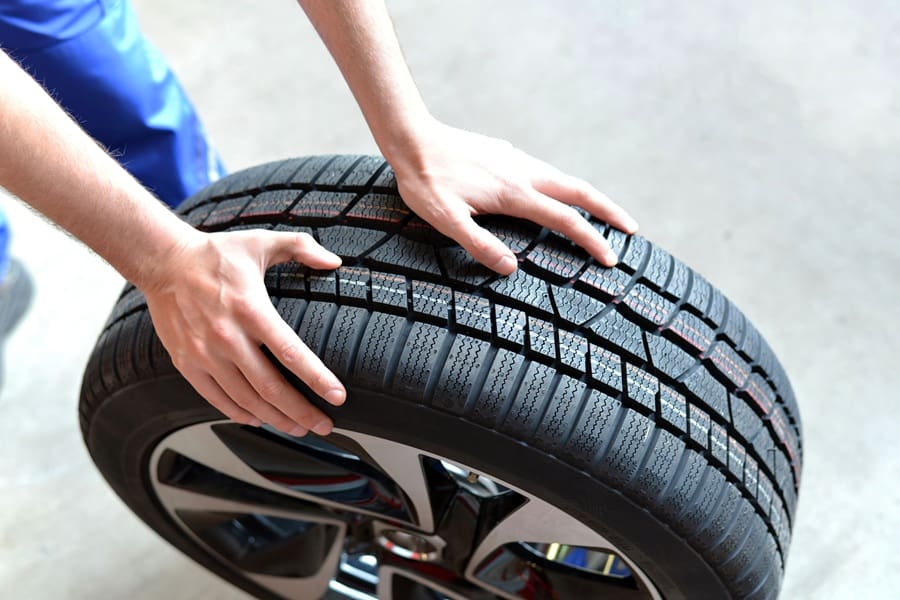
Winter tires have a softer rubber compound that remains flexible even at low temperatures, and a tread pattern with many fine grooves (sipes) that interlock with snow and ice. They perform best in cold, wet, snowy, and slushy conditions. In Germany, as of October 1, 2024, only tires bearing the Alpine symbol—a mountain pictogram with a snowflake (3PMSF)—are legally considered winter tires.
Summer tires
Summer tires have a harder rubber compound and a tread pattern with fewer sipes. In warm temperatures, they offer shorter braking distances and more precise handling than winter tires. However, in cold weather, snow, and ice, they lose a significant amount of traction. Therefore, driving with summer tires is not permitted under winter road conditions.
All-season tires
All-season tires are a compromise between the two types of tires. They eliminate the need for seasonal tire changes, but depending on the model, they offer neither the winter nor the summer performance of specialized tires. Legally, they are considered winter tires only if they bear the Alpine symbol. For company cars that are primarily driven in cities and regions with mild winters, they can be a sensible option; however, they are generally not recommended for frequent drivers working in the field or in low-mountain regions.
Winter Tire Requirement: When Does It Take Effect?
In Germany, Section 2(3a) of the Road Traffic Regulations (StVO) governs the situational requirement for winter tires. It does not take effect on a specific date, but rather whenever winter road conditions prevail: black ice, snow-covered roads, slush, or roads covered with ice or frost. In such cases, all wheels must be equipped with winter tires or all-season tires bearing the Alpine symbol.
The rule of thumb that has become established is “from O to O”—that is, from October to Easter. While this timeframe is not legally binding, it serves as a good guideline for fleet planning.
Anyone who violates the winter tire requirement risks the following penalties according to the schedule of fines (as of October 2026):
| Violation | Fine | Points |
|---|---|---|
| Driving without proper tires | 60 euros | 1 |
| … to the detriment of others | 80 euros | 1 |
| … endangering others | 100 euros | 1 |
| … resulting in an accident | 120 euros | 1 |
| The vehicle owner orders or permits the trip | 75 euros | 1 |
For companies, the last line is crucial: The vehicle owner can also be held liable if he orders or permits a trip to be taken with unsuitable tires. This means that both the driver and the vehicle owner can be fined at the same time. In addition, there may be consequences for insurance coverage if an accident involving unsuitable tires is deemed to be the result of gross negligence.
Anyone driving a company car abroad should be familiar with the local regulations. In Austria, for example, the situational requirement applies from November 1 through April 15. In Germany, commercial vehicles weighing more than 3.5 metric tons are subject to additional requirements for individual axles, which fleet managers should review separately.
Tires as Part of Maintenance and Servicing
Maintenance and servicing are often used interchangeably in everyday language, but they do not mean the same thing. According to DIN 31051, “servicing” is the umbrella term. It encompasses maintenance (preventive measures such as oil changes or seasonal tire changes), inspection (checking the condition), repair, and improvement. Tire management touches on all four areas and should therefore not be treated in isolation but organized as part of maintenance management .
The following points are particularly important for ongoing monitoring:
- Tread depth: The legal minimum is 1.6 millimeters. Experts recommend a minimum of 4 millimeters for winter tires and 3 millimeters for summer tires, because traction decreases significantly as the tread wears down.
- Tire Pressure: Low tire pressure increases wear and tear and fuel consumption and impairs handling. Newly registered passenger cars have been equipped with a tire pressure monitoring system (TPMS) since November 2014. However, this does not completely replace the need for regular checks.
- Tire Age: There is no legally mandated maximum age. The date of manufacture can be determined from the DOT number on the tire sidewall. As tires age, the rubber loses elasticity; therefore, older sets should be inspected with particular care.
- Damage: Employees should report any cracks, dents, or foreign objects instead of continuing to drive. Tires are also included in the annual operational safety inspection of passenger cars and vans used for commercial purposes.
Organizing Tire Changes for 50+ Vehicles
For large fleets, planning determines whether the tire change goes smoothly or whether company cars are still on the road with summer tires when the first icy conditions hit. A six-step approach has proven effective:
- Inventory: For each vehicle, document which sets of tires are available, where they are stored, how much tread depth they have, and whether they bear the Alpine symbol.
- Set a timeframe: Plan the tire change well in advance—around mid-October and mid-April—and spread it out over several weeks to avoid having too many company cars out of service at the same time.
- Consolidate workshop partners: Enter into framework agreements with tire service providers or workshop networks that are available at all relevant locations and also handle storage.
- Involve drivers: Automatically remind employees of their appointments, provide them with the name of the repair shop, and request feedback on any damage or issues.
- Gather documentation: Record tire changes, tread depth, and invoices for each car so that the status can be tracked at any time.
- Follow-up: After the time window has ended, check where tire replacements are still pending and follow up specifically on those cases.
It is important to clearly define responsibilities: Who schedules the appointments, who monitors implementation, and who decides on the replacement of worn-out sets? For leased vehicles, another consideration is whether tires and tire changes are included in the lease agreement and which service provider is designated for this purpose.
Where Costs Can Be Reduced
Tires are a recurring expense that can be managed much more effectively with good organization:
- Consolidating Purchases: Framework agreements with tire service providers generally offer better terms than individual orders.
- Use the remaining tread depth: If you know the condition of each tire, you can replace it at the optimal time—neither too early nor too late.
- Avoid downtime: Scheduled appointments prevent last-minute breakdowns and ensure employees’ mobility.
- Avoid Fines and Damage: Tires that are replaced and inspected on time reduce the risk of accidents, fines, and disputes with insurance companies.
- Make costs transparent: Only by analyzing tire costs per vehicle can you identify outliers, such as unusually high wear.
Digital Management with Fleet Management Software
When managing large fleets, Excel spreadsheets and email chains quickly reach their limits (see also our article on managing large fleets). Fleet management software centralizes all information and automates recurring processes.
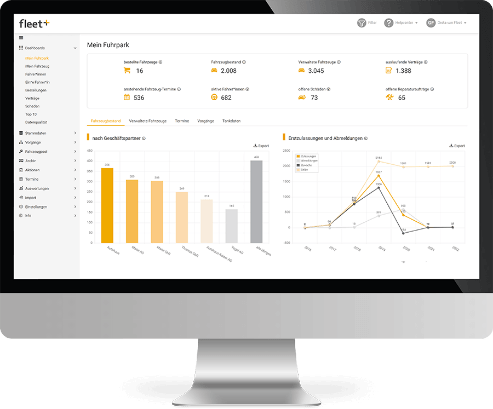
With Carano Fleet+, the CarWise Group’s fleet management software, fleet managers can centrally schedule maintenance and service appointments in a single system. Recurring tasks, such as seasonal tire changes, can be individually scheduled and automatically monitored. Automatic reminders provide timely notifications of upcoming tasks. Repair and maintenance orders can be assigned to repair shops, contracts can be awarded, and repair approvals can be managed centrally. Every task is documented in the vehicle’s technical history, and analyses of maintenance costs highlight areas for optimization.
Tires for Leasing Companies and Mobility Providers
With full-service leasing contracts, the leasing company often handles the organization of maintenance and tires. This also applies to mobility providers who manage fleets for their customers. For them, the same challenge arises on an even larger scale. In LeaseWise, maintenance, damage, and other transactions are assigned to the respective asset and processed automatically via interfaces. For more information, see the Asset Management page.
Conclusion
- The requirement to use winter tires in Germany depends on the situation: In winter road conditions, tires bearing the Alpine symbol are mandatory; as of October 2024, the M+S marking alone is no longer sufficient. Vehicle owners may also be subject to a fine.
- Tire management is part of vehicle maintenance and includes inventory, rotation, storage, condition checks, and costs.
- For fleets of 50 or more vehicles, fixed time slots, designated repair shop partners, and digital reminders are key to a smooth and efficient process.
FAQ on Tires for the Fleet
In Germany, the requirement for winter tires applies on a situational basis rather than as of a fixed date: As soon as there is black ice, snow-covered roads, slush, or icy or frosty conditions, winter tires or all-season tires with the Alpine symbol are required. As a general guideline, the rule of thumb is “from O to O,” meaning from October to Easter.
First, take inventory of the tires on each vehicle, set specific time windows in the spring and fall, and spread the appointments out over several weeks. Coordinate tire changes and storage with repair shop partners under framework agreements, automatically remind drivers of their appointments, and check after the time window has expired to see which tire changes are still pending. Fleet management software handles reminders, repair shop assignments, and documentation.
No. As of October 1, 2024, only tires bearing the Alpine symbol are considered winter tires in Germany. Tires that bear only the M+S marking no longer meet the winter tire requirement.
Both. The driver pays a fine of 60 euros or more and receives one point. The vehicle owner who orders or permits the vehicle to be driven with unsuitable tires pays 75 euros and also receives one point. For companies, maintaining a documented tire management system is therefore also a matter of owner responsibility.
The legal minimum is 1.6 millimeters. The recommended minimum is 4 millimeters for winter tires and 3 millimeters for summer tires.
According to DIN 31051, “maintenance” is the umbrella term that encompasses servicing, inspection, repair, and improvement. Servicing refers to the preventive measures taken to maintain a car’s condition, such as oil changes or seasonal tire changes.
Other useful articles
- Fleet safety: How to minimize the risk of fleet accidents
- Driver instruction according to UVV: Download template as PDF
- Safety and transparency in the vehicle fleet: why a company car policy is essential
- The 5 advantages of fleet management software for your company
- Changing claims management: 83% report increasing complexity in the vehicle fleet