The demands on fleet managers are noticeably increasing. According to the Dataforce Fleet Management Study 2024, 9 out of 10 tasks performed by fleet managers of large fleets have become more complex and extensive in recent years. This trend affects not only economic and organizational issues but, in particular, the legal responsibilities associated with vehicle owner liability within the fleet.
After all, anyone who is responsible for vehicles in the company not only has operational tasks, but also a clear legal obligation. Even minor omissions in driving license checks, UVV instruction or documentation can have considerable legal consequences. Particularly in road traffic, strict strict liability applies, which applies regardless of the driver.
From CarWise’s perspective, owner liability is therefore not merely a technical legal detail, but rather a reflection of the growing organizational complexity within a fleet. In this article, we explain what owner liability actually means, what obligations fleet managers must fulfill, and how responsibility can be structured and organized in a legally compliant manner.
Contents
- 1. What does owner liability mean in the vehicle fleet?
- 2. Who is the vehicle owner?
- 3. Transfer of keeper duties in the vehicle fleet: How are duties delegated?
- 4. What are the requirements for the transfer of owner liability?
- 5. Delegation does not release you from responsibility
- 6. What are the legal obligations of owner liability?
- 7. Holder liability is decided in an emergency
- 8. What are the consequences of ignoring owner liability?
- 9. How do software solutions support compliance with keeper liability?
What does owner liability mean in the vehicle fleet?
Owner liability in the vehicle fleet means that the vehicle owner can be held liable for any damage caused, regardless of who was driving the vehicle at the time of the damage. This is regulated by §7 of the Road Traffic Act ( StVG ).
The legal basis is based on the principle of strict liability, whereby it is not the driver but the owner who is liable for the potential danger posed by the operation of a vehicle on the road. In this context, it is irrelevant whether the driver was an employee or an external service provider, for example – in case of doubt, the person who is responsible for the vehicle is always liable.
§7 des StVG (Straßenverkehrsgesetz)
“(1) If, in the course of operating a motor vehicle, a person is killed, a person’s body or health is injured, or property is damaged, the owner is obligated to compensate the injured party for the resulting damages.”
It does not matter whether there are three company cars or 500 pool vehicles – compliance with the keeper obligations is of great importance for the vehicle owner in order to avoid conflicts with the law.
Who is the vehicle owner?
In the vehicle fleet, the vehicle owner is the person who has the economic use of the vehicle and bears its costs. He is responsible for the proper registration, insurance and compliance with legal regulations in connection with the ownership and operation of the vehicle. A judgment of the Cologne Higher Regional Court of 08. 10.1993 states:
The Cologne Higher Regional Court defines the keeper, or vehicle owner, as the person who uses the vehicle on their own account and in their own interest on a more than temporary basis and has control over it.
From a purely legal point of view, in most cases the management or board of directors is considered the owner of a vehicle, even if they do not use the vehicle themselves.
However, the vehicle keeper is not always the vehicle owner. This is the person or legal entity that legally owns the vehicle and can sell, lend or otherwise dispose of it. In the case of leased vehicles, for example, the lessor remains the owner of the vehicle. In the case of financed vehicles, the credit institution may also remain the owner of the vehicle until the loan has been repaid in full. The driver, on the other hand, is always the person who moves or drives the vehicle.

Transfer of keeper duties in the vehicle fleet: How are duties delegated?
When transferring keeper liability in the vehicle fleet, responsibility for compliance with the obligations is delegated to another person or organization. Usually, the owner’s liability is transferred to a person with the appropriate character and expertise. This is usually the fleet manager.
The transfer of owner liability in the fleet does not mean that the company has been released from its obligations with regard to compliance with legal provisions and safety measures. The company still has a duty of control and supervision and should therefore regularly review the work of the fleet manager.
Particularly in cases of infringements – such as parking violations – liability cannot be passed on entirely to third parties. The owner’s responsibility remains and includes both monitoring the drivers used and ensuring that all traffic regulations are complied with.
What are the requirements for the transfer of owner liability?
The delegation of keeper liability must always be in writing and explicit. To minimize potential legal and financial risks, companies should always ensure that they make clear agreements and adequately consider all relevant aspects of keeper liability and its delegation. There are a few legal pitfalls lurking here. If certain points do not apply, there is a so-called organizational fault and the management is ultimately liable.
- Written contract: In order to clearly regulate the transfer of keeper liability in the fleet, it is advisable to put this in writing. This is best done either in the employment contract of the fleet manager or in a separate contract.
- Clear wording: All necessary tasks and responsibilities should be clearly formulated in this document.
- Personal suitability: It is important that the person to whom the keeper liability is transferred has the necessary qualities and skills in line with the tasks.
- Automatic delegation: Automatic delegation of keeper liability may only occur if the person concerned has been performing these tasks for more than five years or is qualified to do so on the basis of their professional qualifications.
Delegation does not release you from responsibility
In practice, it has been shown time and again that written delegation alone is not sufficient to organize owner liability in a legally secure manner. The increasing complexity of fleet management means that monitoring and documentation obligations have become much more extensive. A one-off delegation of tasks without ongoing monitoring can quickly lead to organizational negligence.
From CarWise’s perspective, the real challenge therefore lies less in formal delegation and more in structured implementation in day-to-day operations. Those who delegate responsibilities must also ensure that processes are clearly defined, checks are performed regularly, and results are documented in a traceable manner. Only in this way can it be demonstrated in an emergency that the vehicle owner’s responsibility was secured not only on paper but also organizationally.
It is therefore crucial to define responsibilities, inspection routines and escalation paths transparently, especially for larger or growing fleets. Delegation is not a one-off act, but an ongoing organizational process.
What are the legal obligations of owner liability?
In connection with owner liability in the fleet, the fleet manager has various obligations to fulfill in order to ensure compliance with the law and safety in the fleet. The obligations include organizational, technical and documentary measures that must be regularly reviewed and verifiably implemented. These include:
Driver’s License Check
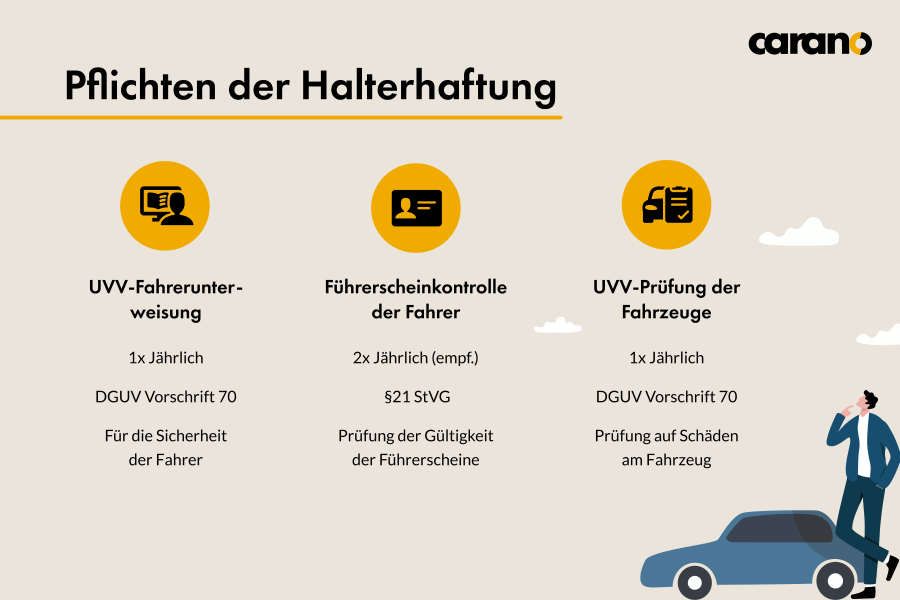
As driving without a valid driver’s license is punishable under §21 of the Road Traffic Act ( StVG ), fleet managers must regularly check the validity of drivers’ licenses and the required driving license category.
However, the law does not specify how often driving license checks should be carried out. This should depend on the individual requirements of the fleet. A six-monthly check is recommended. However, checks can also be carried out more frequently if, for example, fines accumulate or more damage occurs to the vehicles.
A typical example is when a company car driver is found to be driving under the influence of alcohol and has their license revoked. As fleet manager, it is then your responsibility to prohibit the use of the company car until a valid driver’s license is available again.
UVV Driver Training
Company vehicles are considered work equipment, which is why employees must be regularly trained in their safe use as part of accident prevention driver training. This is intended to ensure the safety and health of employees who drive vehicles for work and minimize the risk of accidents.
The instruction should cover core topics such as vehicle operation, safety equipment, accident prevention and behavior in the event of accidents. Depending on the requirements of the company and the type of vehicles in the fleet, the content should be adapted accordingly. It is a legal requirement that UVV driver training must be carried out before every first journey and then at least once a year.
UVV inspection of the vehicles
Furthermore, failure to recognize and rectify vehicle defects in good time can also be considered a breach of the owner’s liability obligations. The UVV vehicle inspection is therefore also part of the owner’s liability. It is intended to ensure the operational safety and suitability of company vehicles.
Vehicles must be checked for possible damage or defects at least once a year. This UVV inspection itself must be carried out by a competent person to ensure a professional assessment of each vehicle.
Holder liability is decided in an emergency
As long as all inspections are carried out on time, keeper liability often remains abstract. However, it becomes relevant the moment an accident, personal injury or official proceedings occur. Then the question is no longer whether an obligation was known in principle, but whether it was fulfilled in a concrete, timely and comprehensible manner.
In the event of a claim, the burden of proof lies with the keeper or the responsible organization. It is not enough to carry out regular checks “as usual”. The decisive factor is whether these are fully documented and can be presented at any time in case of doubt. This is precisely where it becomes clear how quickly organizational negligence can turn into a liability-relevant problem.
From CarWise’s perspective, owner liability is therefore not a theoretical risk, but rather a matter of being able to provide reliable evidence. Those who fail to document their processes will have a hard time proving them in the event of an emergency.
What are the consequences of ignoring owner liability?
Compliance with keeper liability is of the utmost importance, as the safety of human life is always at stake here. The legislator therefore intervenes rigorously if owner liability is neglected or disregarded in fleet management. All inspection results must also be fully and comprehensibly documented so that you can provide appropriate evidence in the event of a claim.
The penalties for the vehicle owner resulting from failure to fulfill these obligations are both criminal and civil in nature and can entail significant financial consequences amounting to several thousand euros. Fleet managers who allow company vehicles to be driven without a valid driver’s license risk imprisonment or a fine under Section 21 of the StVG. In the event of an accident, insurance coverage may also lapse.
It is therefore of the utmost importance that you, as the person responsible for the vehicle fleet, conscientiously fulfill your owner liability obligations in order to avoid possible consequences.
How do software solutions support compliance with keeper liability?
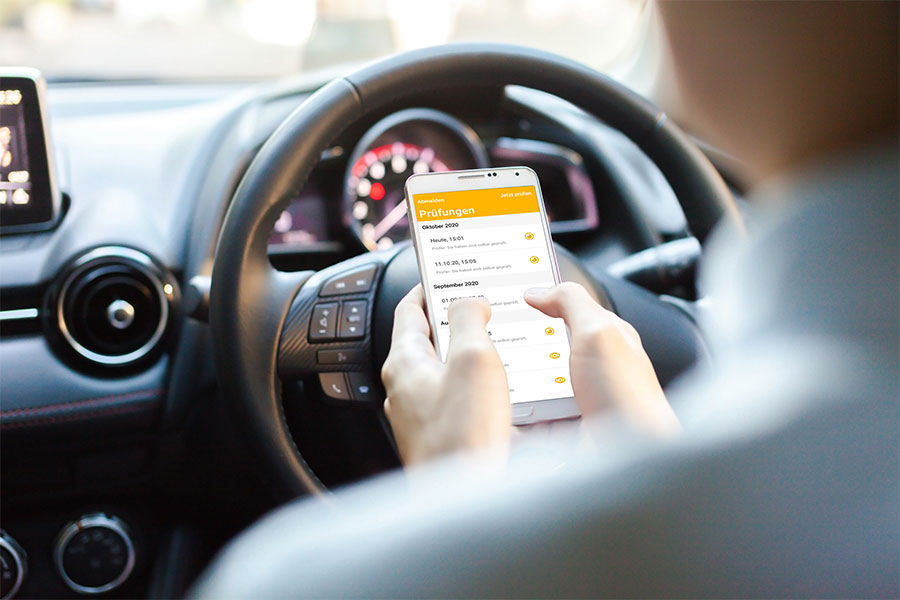
Today, it’s impossible to imagine fleet management without software solutions. As a digital tool, fleet management software provides valuable support for fleet managers and makes it easier to comply with vehicle owner liability requirements thanks to apps and desktop applications. Take advantage of these opportunities to not only meet legal requirements but also improve safety and efficiency within your fleet.
In addition, digital systems enable automated reminders of deadlines, inspection intervals and training courses – thereby minimizing sources of human error. Intelligent functions also ensure legal protection and significant time savings when assigning vehicles, checking driving licenses or documenting damage. Especially in larger fleets, a central software solution offers a decisive advantage in the organization of complex processes.
Driver’s license verification
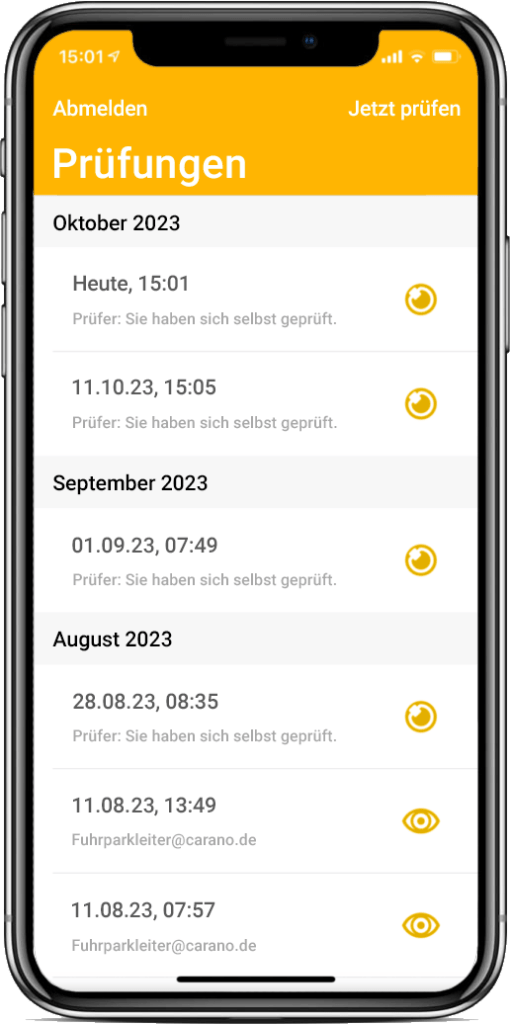
One component of such digital solutions is electronic driver’s license verification. It offers a wide range of benefits to both fleet managers and drivers. For one thing, it saves a lot of time and offers great flexibility, since it can be carried out quickly and easily from anywhere. The software also sends reminders for upcoming and overdue appointments and stores all inspection results in a traceable manner.
UVV driver training as an e-learning course
Another solution for digital owner liability is UVV driver training as an e-learning course. This flexible form of instruction allows drivers to be trained regardless of time and location. This saves fleet managers a lot of time and effort, as the content has already been prepared and is immediately available. The time-consuming organization of appointments is completely eliminated. All instructions and test results are also stored seamlessly.
Reminder and documentation for UVV inspection
With fleet management software like Carano Fleet+, you—as the fleet manager—can always keep track of upcoming appointments and have complete documentation at your fingertips. In addition to UVV inspections, you can also set reminders for other important appointments, such as HU or TÜV inspections.
FAQ – Important questions on the subject of keeper liability
Violations can result in fines, criminal prosecution and civil liability – for example in the event of accidents or failure to check drivers.
The vehicle owner, usually the company, is generally responsible. Operational responsibility can be delegated to a fleet manager, but overall legal responsibility remains with the owner.
Owner liability means that the vehicle owner is liable for damage and breaches of duty in connection with the operation of a vehicle – regardless of who was driving.
By a written assignment to a professionally and personally suitable person, e.g. the fleet manager. It is important that the company regularly monitors compliance with all obligations.
In principle, the vehicle owner is liable within the scope of strict liability according to §7 StVG. If there is no insurance cover or if this is voided due to breaches of duty, the owner can be held personally liable. In addition, the driver is liable for intentional or grossly negligent behavior.
In the case of company cars, the company is usually the vehicle owner, as it has the economic power of disposal and bears the costs. This means that the management is usually legally responsible, even if a fleet manager takes on the operational tasks. Use by an employee does not automatically make them the owner.
First, the vehicle owner is identified. If the driver responsible is identified, they are liable for the fine. If the driver cannot be identified, the owner may face costs or a logbook requirement.
From Carano’s point of view, this shows how important clear allocation and documentation processes are in the fleet.
- Vehicle owner: economic use and power of disposal
- Owner: legal owner of the vehicle
- Owner: actual control of the property
- Driver: drives the vehicle at the specific moment
The decisive factor for keeper liability is who is considered the keeper – not necessarily who is the owner or driver.
Digital solutions help to monitor deadlines, document inspections and store evidence without gaps. This documentation is particularly crucial in the event of a claim.
Carano relies on structured digital processes that transparently map organizational responsibility and provide legally compliant support.
Other useful articles on the topic of keeper liability
- Employer Driving License Check: Legal Regulations and Tips for Implementation
- Driver’s license check form: Free download template
- Driver instruction according to UVV: Download template as PDF
- UVV inspection in the vehicle fleet: definition and importance in the vehicle fleet
- 10 Tips for Successful and Efficient Fleet Management