
The vehicle fleet is one of the company’s largest cost centers. This makes it all the more important—especially for large fleets —to keep track of all costs at all times and identify potential savings. Calculating the Total Cost of Ownership (TCO) for the fleet plays a central role in this process. In this article, we explain exactly what TCO means in the context of a fleet, what it consists of, and how it helps manage the fleet cost-effectively.
What does Total Cost of Ownership mean in the vehicle fleet?
In fleet management, the Total Cost of Ownership (TCO) refers to the total operating costs associated with owning and using vehicles. TCO takes into account not only the initial purchase cost but also all expenses incurred over the entire life cycle of a vehicle. A TCO analysis thus provides an important basis for making investment decisions regarding the fleet and for determining whether it is still worthwhile to maintain certain vehicles.
Studies by Dataforce show that TCO monitoring is becoming increasingly important in fleet management. While in 2021 only about 26 percent of fleet managers regularly calculated the TCO of their vehicles, that figure had already risen to 60 percent in 2022. However, this also means that about 40 percent of fleets do not examine their costs in detail.
Why is the calculation of the total cost of ownership important in the fleet?
By accurately calculating all direct and indirect cost factors, hidden expenses and cost drivers within the fleet can be identified, and targeted measures for cost optimization can be implemented. TCO analysis is therefore an important tool for evaluating the economic profitability of vehicles in the fleet. By comparing different models in terms of their total costs, it is possible to determine which vehicles are more cost-effective in the long term. Uneconomical models that generate high costs within the fleet can be identified and replaced with more affordable vehicles.
By taking all relevant cost factors into account, it provides a comprehensive view of a vehicle’s actual costs over its entire lifecycle. Fleet managers can use TCO calculations to make informed decisions regarding vehicle selection, procurement strategies, maintenance plans, and financing options.
In addition, the analysis provides transparency and enables meaningful reporting. Stakeholders, such as management or the finance department, receive accurate information about the fleet’s financial performance and can thus assess its impact on the company in a targeted manner.
It is recommended to conduct a TCO analysis at least once a year and to use the results to identify appropriate measures for cost optimization. Compiling all the individual items may seem tedious at first, but in the long run, it is necessary for the economical management of the fleet.

What does the TCO in the fleet consist of?
The total cost of ownership for a vehicle fleet consists of several factors that should be considered as a whole. Particularly when making investment or purchasing decisions, all hidden costs should be identified in advance in order to make well-informed decisions. Indirect costs, in particular—which may not be immediately apparent—are often overlooked in the overall calculation. These include administrative and overhead costs, such as office rent, hardware and software, and telephone and electricity bills.
Acquisition costs
The costs associated with purchasing a vehicle typically include the vehicle price, the cost of optional features and accessories, as well as any taxes and fees for registration and delivery. When choosing additional features, you should consider not only the cost but also the car’s resale value. After all, having countless extras does not automatically mean the vehicle will retain its value.
Financing costs
When vehicles are financed through financing options such as loans or leases, interest or lease payments are incurred. These costs are also included in the TCO analysis.
Current operating costs
This includes the ongoing costs associated with operating the vehicles. These costs must not be overlooked when calculating the total cost of ownership for the fleet, as they account for a significant portion of the total operating costs. These include fuelor energy costs, maintenance and repairs, insurance, taxes, tire replacements, spare parts, car washes, traffic tickets, and other expenses related to vehicle use. In this context, it can be helpful to explore alternatives that don’t drive up fleet costs as much. Many companies are already using modern solutions such as corporate carsharing or company bicycles as alternatives to traditional company cars. These can significantly reduce operating costs.
Administrative Costs
Administrative costs include, for example, the costs of managing the fleet, such as the salaries and working hours of employees tasked with fleet management , the costs of software solutions and service providers, as well as other administrative expenses. Using fleet management software can lead to more efficient processes and thus significantly reduce administrative costs. This allows companies to effectively lower their TCO.
Loss of value
Depreciation refers to the decline in a vehicle’s value over time. Vehicles lose value due to aging, wear and tear, and market factors. Depreciation must also be taken into account in the TCO calculation, as it represents a significant cost factor. Regular maintenance and care of vehicles can extend their service life and thus reduce depreciation. This can have a positive impact on the total costs of the fleet.

E-vehicles with low TCO
As many fleets make the switch to electric mobility, the TCO analysis is taking on new relevance. When purchasing electric vehicles , a detailed calculation of total cost of ownership should be performed. Even though the upfront costs for electric vehicles are generally higher than for internal combustion engine vehicles, electric vehicles can be more cost-effective overall due to their lower operating costs.
Since the motors in electric vehicles contain fewer parts prone to wear and tear, maintenance and repairs are less expensive than for conventional internal combustion engine models. Electric cars also require the same insurance coverage as vehicles powered by gasoline or diesel. This coverage should include protection against specific risks, such as damage caused by improper charging or animal bites to the electronics.

According to the comparison portal Check24, car insurance for an electric car can even be up to 42 percent cheaper.
However, there are other cost factors that must be taken into account in the calculation. These include electricity costs and potential costs for the installation and maintenance of charging stations to enable employees to charge their vehicles on company property.
Simplify the TCO calculation with the help of software
To ensure that all costs are taken into account in the analysis, all receipts and invoices must be collected, assigned to the vehicles, and evaluated. This takes a lot of time in an already very complex field of work and often results in a pile of paperwork on the desk. Large fleets, in particular, quickly reach their limits when calculating the Total Cost of Ownership using Excel. The more vehicles a company has, the more confusing the process becomes. This can lead to errors that have negative consequences for the entire company.
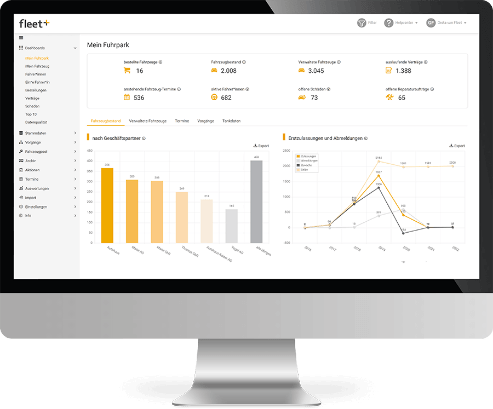
Fleet management software makes it easier to break down and analyze total cost of ownership. Thanks to reports and analyses available at the click of a button, cost drivers within the fleet can be quickly identified, and corresponding savings opportunities can be derived from them. The software not only minimizes the time and effort required but also ensures the necessary transparency within the fleet. This allows fleet managers to Manage your fleet efficiently and cost-effectively. To learn about the other benefits a digital solution offers for day-to-day fleet operations, read our article“5 Benefits of Fleet Management Software.”
Conclusion
- The TCO analysis offers a holistic view of all vehicle costs incurred and helps to uncover hidden expenses.
- With the help of software solutions, TCO data can be automatically recorded and analyzed, which speeds up decision-making and enables cost-efficient fleet strategies.
- A well-founded TCO calculation supports long-term budget planning and minimizes financial risks in fleet management.
FAQ – Total Cost of Ownership
The total cost of ownership (TCO) for a vehicle fleet includes all costs incurred over the entire useful life of a vehicle. In addition to the purchase price, this includes expenses for fuel, maintenance, repairs, insurance, taxes, and depreciation.
TCO is important because it provides a comprehensive overview of all the costs associated with a vehicle, thereby enabling informed decisions. By analyzing TCO, companies can select cost-effective vehicles, identify potential savings, and optimize the cost-effectiveness of their fleet over the long term.
TCO is calculated by adding up all the costs associated with a vehicle over its entire useful life. This includes fixed costs such as lease payments or depreciation, as well as variable costs such as fuel, maintenance, repairs, and insurance. A detailed analysis helps ensure that all relevant items are included and that hidden costs are identified.
Further articles on the subject of TCO and fleet management
- Fleet management tasks: The 10 most important fleet activities
- Fleet analysis: Analyzing the fleet step by step
- Car Policy: Significance and advantages of a company car policy in the vehicle fleet
- Fuel cards for companies: Efficient management of fuel costs in the fleet
- Sustainable vehicle fleet: measures for more environmental and climate protection in the fleet
- Is a company car worth it?