According to the Federal Statistical Office, trucks registered in Germany transport approximately 2.8 billion metric tons of goods annually. An efficient fleet is therefore the backbone of every transportation and logistics company. However, high operating costs, increasing regulatory requirements, a shortage of skilled workers, and digitalization are putting greater pressure on fleet managers.
Anyone who manages dozens or hundreds of vehicles on a daily basis can hardly afford unplanned downtime or missing information. To use vehicles cost-effectively and meet delivery commitments, transparent processes and proactive fleet management are essential.
This article highlights which challenges are particularly relevant today, which cost factors companies should keep an eye on, and how modern fleet management software can help.
Contents
- 1. Why fleet management is particularly challenging in transportation and logistics
- 2. Current challenges in the transportation and logistics industry
- 3. Cost structure of a logistics fleet
- 4. Efficient fleet management as a productivity factor
- 5. Safety and compliance in the logistics fleet
- 6. What Carano Fleet+ offers logistics companies
- 7. Transportation and logistics in transition: trends, challenges, and solutions
- 8. Transportation and logistics: future-proofing the fleet
- 9. FAQ – Frequently asked questions about fleet management in transportation and logistics
- 10. Other useful articles
Why fleet management is particularly challenging in transportation and logistics
In transportation and logistics companies, the fleet is far more than just a collection of vehicles—it is essential for smooth business operations. If a vehicle breaks down or ends up in the shop unexpectedly, it has an immediate impact on route planning, delivery schedules, and customer satisfaction.
Since 2008, the number of trucks in Germany has increased by about 65 percent. As the number of vehicles grows, so do the demands on planning, maintenance, cost control, and compliance. Professional fleet management is therefore becoming a key factor for success in the transportation and logistics industry.
In addition, requirements vary significantly from company to company: Regional distribution operations place different demands on a fleet than a long-haul carrier with international routes or a freight forwarding company with a mixed fleet of trucks, trailers, and vans. Fleet management in transportation and logistics is therefore difficult to standardize.
High vehicle utilization and mileage
Since 1991, the mileage of road freight transport has increased by about 69%—and the demands on vehicles and fleet management are correspondingly high.
High mileage increases wear and tear and shortens the available time windows for maintenance. However, if necessary work is performed too late, there is a risk of unplanned vehicle breakdowns. On the other hand, extended stays in the shop reduce available transport capacity.
In our experience, many companies initially focus only on the repair shop bill. However, the actual costs often arise afterward—for example, due to rescheduling, delayed deliveries, or the last-minute use of replacement vehicles.
Different vehicle types and operational profiles
A logistics fleet often consists of vehicles with very different tasks. These include tractor-trailers, trucks, trailers, semi-trailers, vans, passenger cars, as well as refrigerated or specialty vehicles.
In practice, this often means that different maintenance cycles, inspection intervals, and cost models must be managed simultaneously within a single fleet. It is precisely this diversity that makes standardized workflows particularly important.
The operational profile is also relevant: A van used in city traffic is subjected to different stresses than a long-haul truck. Vehicles should therefore be evaluated not only by type, but also by usage and lifecycle costs.
Time-sensitive processes
A single vehicle breakdown can disrupt the entire transportation schedule at short notice. Delivery windows, connecting trips, and staffing are closely coordinated.
Especially in general cargo or distribution transport, the breakdown of a single vehicle can trigger a chain reaction because routes, drivers, and time slots are directly interdependent.
Maintenance, inspections, and repairs must be carried out in a timely manner without unnecessarily disrupting ongoing operations. Economic time pressures must not lead to the postponement of safety-related measures.
Decentralized structures
Vehicles and drivers are usually spread across different locations or constantly on the road. Nevertheless, information on damage, mileage, workshop appointments, and documents must be centrally available and up to date.
When information is managed in local spreadsheets, paper files, or emails, discrepancies in data can quickly arise. This leads to an increase in follow-up questions, tasks being duplicated, or important deadlines being missed.
From our project experience, we know that information loss is rarely caused by missing data. Often, differing processes, local Excel files, or inconsistent responsibilities are the actual causes.
Numerous internal and external stakeholders
Fleet management is a cross-functional task. In addition to fleet management and executive management, dispatch, drivers, repair shops, accounting, purchasing, and human resources are often involved.
Added to this are external partners such as insurance companies, leasing companies, inspection organizations, fuel card providers, and vehicle manufacturers. At every handoff point, information can be lost or processing can stall.
Current challenges in the transportation and logistics industry
Transportation and logistics companies must ensure their ability to deliver under increasingly difficult conditions.
For fleet managers, five developments are particularly relevant:
- Rising and fluctuating operating costs—such as fuel, energy, tolls, insurance, vehicles, replacement parts, and repair services— weigh on the fleet’s profitability. Because prices sometimes change on short notice, cost calculations and budget planning become more difficult. Companies therefore need transparency regarding costs per vehicle, kilometer, and assignment.
- Shortage of skilled workers and drivers: According to the Federal Association of Road Freight Transport, Logistics, and Waste Management (BGL), there will be a shortage of approximately 120,000 truck drivers in 2025. As a result, existing vehicles often cannot be utilized to their full capacity, while fewer employees must handle the workload in dispatching, the repair shop, and fleet management.
- Ability to deliver despite limited resources: Limited workshop capacity and long delivery times for vehicles or replacement parts can disrupt transportation operations. Proactive maintenance, procurement, and operational planning are therefore becoming increasingly important.
- Increasing regulatory requirements—including inspection obligations, safety standards, driving and rest periods, and documentation requirements—create additional administrative burdens. Missed deadlines or incomplete documentation can result in fines, service disruptions, and liability risks.
- Sustainability and decarbonization: Transportation and logistics companies must reduce emissions without compromising profitability or delivery capabilities. Alternative powertrains, charging infrastructure, and revised operational models require significant investments. The most suitable solution depends, among other factors, on range, payload, driving profile, and energy supply.
These challenges cannot be viewed in isolation. Rising costs affect investments, the driver shortage impacts utilization rates, and new propulsion technologies are changing how fleets are planned and operated.
Effective fleet management must identify these interrelationships early on and translate them into a long-term fleet strategy.
Cost structure of a logistics fleet
The costs of a logistics fleet consist of fixed and variable expenses. Fixed costs include, for example, lease payments, depreciation, insurance, and taxes. Variable costs arise from, among other things, fuel or electricity, tolls, maintenance, repairs, and tires.
However, our experience shows that while many companies are aware of their fleet costs, they find it difficult to allocate those costs to individual vehicles or areas of operation. As a result, cost differences within the fleet often go undetected.
With Carano Fleet+, fleet costs can be tracked in a structured manner and assigned to vehicles or cost categories. Key metrics such as cost per kilometer, fuel consumption, CO₂ emissions, utilization, and downtime rates highlight cost drivers.
This enables fleet managers not only to examine individual expenses but also to compare vehicles across their entire lifecycle and make investment decisions based on reliable data.
Efficient fleet management as a productivity factor
Effective fleet management is evident not only in lower costs, but above all in the productivity of the entire fleet. This is achieved when vehicles are selected to match their operational profile and are utilized as closely as possible to actual demand. Uneven mileage distribution, unnecessary downtime, or unsuitable vehicle types can impair the efficiency of the entire fleet.
This becomes particularly clear with mixed fleets consisting of both conventional and electric vehicles: range, charging times, and usage profiles must be taken into account during route planning so that electric vehicles can truly realize their potential. Strategically oriented fleet management therefore considers not only individual vehicles but also the efficiency of the entire system—from vehicle selection and route planning to the ongoing analysis of operational data.
Safety and compliance in the logistics fleet
Safety and compliance are essential prerequisites for reliable fleet operations. Fleet managers must ensure that vehicles are roadworthy, that required inspections are conducted, and that legal and operational requirements are met.
The specific obligations that apply depend, among other things, on the type of vehicle, area of operation, and company structure.
The most important tasks include:
- Monitor maintenance, inspection, and testing schedules
- Verify driver’s licenses and required qualifications
- Regularly train drivers in the safe operation of company vehicles
- Fully document vehicle damage
- Comply with occupational safety and load securing guidelines
- Define responsibilities and escalation procedures
- Maintain verifiable and complete records
Standardized processes provide the necessary assurance here: Who checks what, when, and how are the results documented?
Clear responsibilities, automatic reminders, and a central repository help ensure deadlines are met and risks are identified early on.
Load securing as a distinct risk area
In addition to vehicle safety itself, proper load securing plays a central role in the transportation industry. Improperly secured cargo not only jeopardizes traffic safety but can also result in fines and downtime during inspections. Since load securing varies depending on the goods, vehicle type, and loading configuration, the relevant guidelines should not only be known to drivers but also documented in a traceable manner—especially when driver-vehicle combinations change.
Digitalization in transportation and logistics
Digitalization lays the foundation for transparent and efficient logistics processes. However, if vehicle, cost, and order data are stored in Excel spreadsheets, paper files, or separate systems, this leads to duplicate data entry, a high effort required for reconciliation, and inconsistent information.
It is not the number of digital applications that matters, but how they work together: Interfaces between transportation management, telematics, and fleet management software make information accessible across systems and reduce manual work.
Based on our many years of collaboration with transportation and logistics companies, we know that digital transformation rarely fails because of the software. Success requires clear procedures, reliable master data, and a phased implementation. Only then can digital solutions deliver their full benefits.
What Carano Fleet+ offers logistics companies
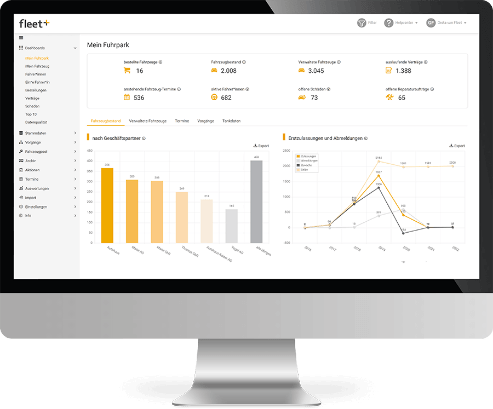
Our fleet management software, Carano Fleet+, consolidates all key information about vehicles, costs, schedules, and documents into a single, centralized system.
This provides fleet managers with an up-to-date overview of the fleet, while at the same time significantly reducing their workload by automating routine tasks.
The most important areas of application include:
- Centrally manage vehicles and vehicle histories
- Monitor maintenance, inspections, and deadlines
- Store contracts and documents in a structured manner
- Digitally record and process damage claims
- Allocate costs to vehicles, locations, or cost centers
- Analyze fuel consumption, utilization, and other fleet metrics
- Manage tasks and responsibilities transparently
As a result, Carano Fleet+ supports not only fleet management but also operational and strategic initiatives. The software reduces manual work, improves data quality, and identifies costs and areas requiring action earlier.
Fleet managers benefit from having all relevant information available without having to ask for clarification or switch systems, especially in their day-to-day operations.
For growing fleets, multiple locations, or complex structures, it provides the transparency needed for cost-effective fleet management.
Transportation and logistics in transition: trends, challenges, and solutions
The transportation and logistics industry is becoming more digital, more connected, and more sustainable. Alternative powertrains, automated processes, and growing volumes of data are changing not only the vehicles in use but also how they are planned and managed. This calls for a fleet strategy that works today while leaving room for future developments.
Companies must integrate new technologies without compromising cost-effectiveness and delivery capabilities.
The following developments are particularly interesting:
- Alternative propulsion systems: Electric, hydrogen, and other propulsion concepts must be evaluated based on range, payload, driving profile, infrastructure, and total cost.
- Connected systems: Data from telematics, transportation management, repair shops, and fleet management should increasingly be accessible across systems.
- Automation and AI: Automated analyses can detect anomalies, support forecasting, and reduce administrative tasks.
- Emissions and cost transparency: Reliable data on fuel consumption, costs, and vehicles serve as the foundation for sustainability goals and forward-looking investment planning.
- New skill requirements: With digital systems and mixed fleets, the responsibilities of fleet management, scheduling, and drivers are also changing.
In practice, it has been shown time and again that not every innovation is equally relevant to every company. Technologies should therefore be deployed strategically where they make a measurable contribution to cost-effectiveness, security, or availability.
Companies achieve the best results when they introduce new solutions gradually and evaluate their benefits based on specific metrics.
Transportation and logistics: future-proofing the fleet
For transportation and logistics companies, future-proof fleet management means combining reliable operations with long-term changes. By transparently mapping costs, vehicle usage, and risks, companies can systematically evaluate new powertrains, digital solutions, and changing requirements.
Companies that continuously improve their processes early on and rely on reliable information lay the foundation for long-term success.
Whether it’s cost pressures, a shortage of drivers, regulatory requirements, or the shift to alternative powertrains—all these developments do not occur in isolation but influence one another. Those who view them separately run the risk of making decisions that seem sensible in the short term but are not sustainable in the long term.
Fleet management software such as Carano Fleet+ provides a central database for this purpose and helps fleet managers develop their fleet in a cost-effective, safe, and phased manner.
FAQ – Frequently asked questions about fleet management in transportation and logistics
Digital fleet management refers to the software-supported administration and control of a vehicle fleet. Vehicle data, costs, schedules, damage reports, and documents are centrally recorded and analyzed. This reduces manual work and creates a reliable foundation for operational and strategic decisions.
In transportation and logistics companies, vehicles play a direct role in service delivery. Breakdowns, missing documents, or missed maintenance can delay shipments and incur additional costs. Professional fleet management helps ensure vehicle availability, safety, and cost-effectiveness.
The biggest cost factors include vehicle purchase or leasing, fuel or electricity, tolls, personnel, insurance, maintenance, repairs, and tires. Vehicle breakdowns also incur costs—for example, due to replacement vehicles, rescheduling, downtime, and delivery delays.
Key fleet metrics include cost per vehicle and kilometer, fuel or energy consumption, vehicle utilization, downtime rate, as well as maintenance, repair, and damage costs. Which metrics are particularly relevant depends on fleet size, vehicle types, and company goals.
Digitalization centrally consolidates vehicle, cost, and process data. It supports the monitoring of schedules, automates recurring tasks, and facilitates cross-location collaboration.
A successful implementation begins with clear goals and prioritized use cases. Companies should then standardize processes, clean up master data, and define responsibilities. A phased rollout and the early involvement of employees promote acceptance in day-to-day work.
Fleet management software is worthwhile as soon as manual routine tasks take up too much time in day-to-day operations, deadlines are missed, or costs can no longer be reliably tracked and allocated. The decisive factor, therefore, is not so much the sheer number of vehicles as the complexity of the fleet.
A future-proof fleet strategy takes into account not only current requirements but also foreseeable developments such as alternative powertrains, increasing regulatory requirements, and growing customer expectations regarding transparency and sustainability. It is important not to make decisions regarding vehicle procurement, processes, and digitalization in isolation, but to consider them in context.
There is no one-size-fits-all answer, but many companies review their fleet strategy at least once a year or as needed—for example, in the event of major investments, new regulatory requirements, or significant changes in the market environment. Regular analyses of cost and usage data provide a reliable basis for this.
Other useful articles
- Fleet management for energy providers: Efficient, digital, and reliable
- Fleet management service providers: How to efficiently digitize your clients’ fleet management