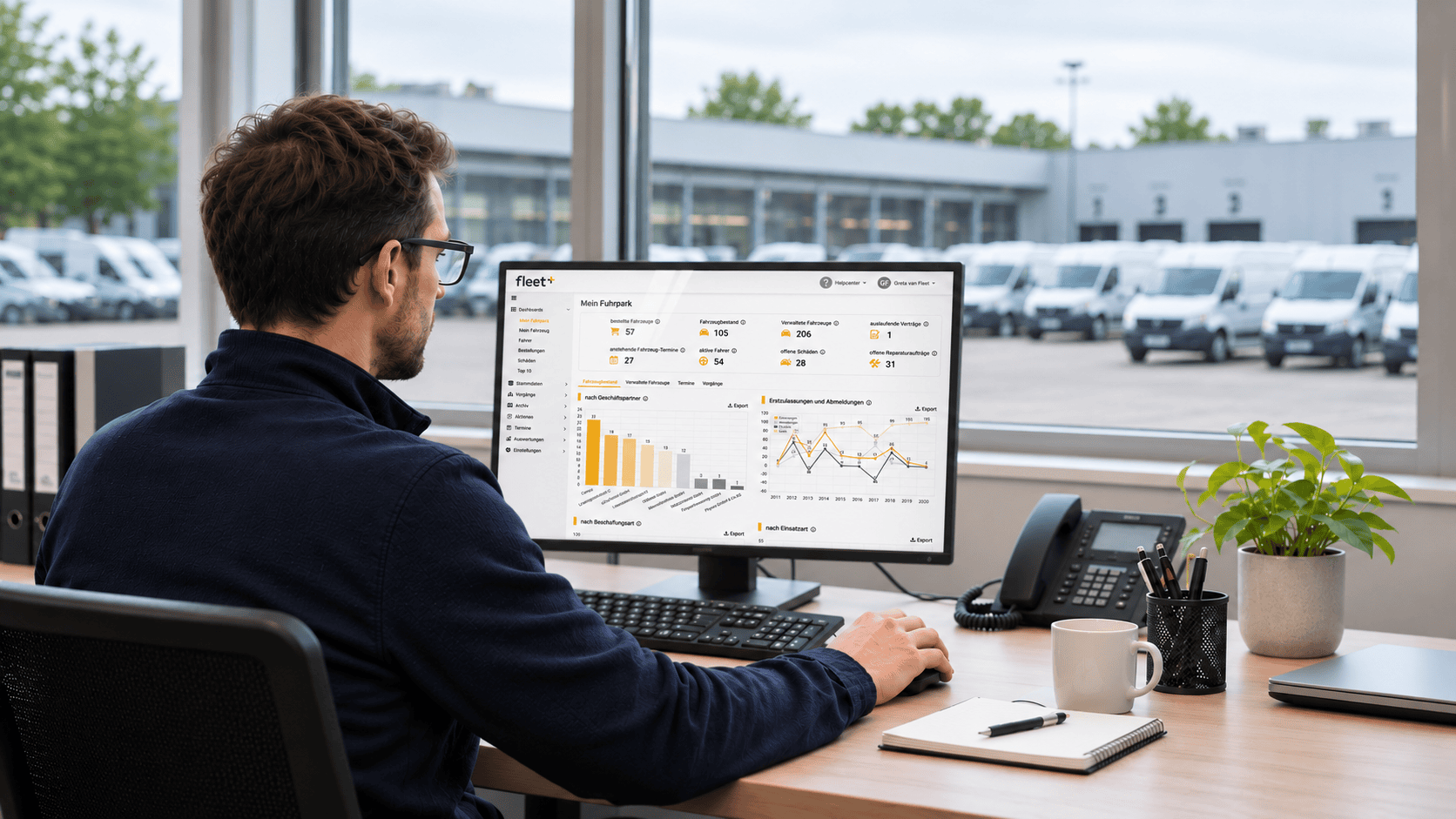
Fleet management service providers face a challenging task today: They not only manage vehicles but are increasingly taking on the role of a strategic partner for their customers. Whether it’s vehicle procurement, owner responsibilities, claims management, or reporting—companies today expect efficient processes, digital services, and reliable support for their vehicle fleets.
At the same time, digitalization, electric mobility, and new mobility concepts are changing the demands placed on fleet management. Manual processes, decentralized data, and Excel spreadsheets quickly reach their limits in this context. Anyone managing multiple customer fleets needs a solution that consolidates information, automates processes, and sustainably reduces administrative overhead.
Fleet management software lays the foundation for this. It helps fleet management service providers reduce administrative burdens, reliably comply with legal requirements, and offer their customers professional service. But what tasks do fleet management service providers actually handle today—and why is a digital software solution increasingly becoming a key factor for success? We’ll explore exactly these questions in this article.
Contents
- 1. What is a fleet management service provider?
- 2. What tasks do fleet management service providers handle?
- 3. The biggest challenges in modern fleet management for fleet service providers
- 4. Why companies rely on fleet management service providers
- 5. The evolving role of the fleet manager
- 6. Why fleet management software is indispensable for fleet service providers
- 7. What features should fleet management software for service providers offer?
- 8. How CarWise supports fleet management service providers
- 9. Conclusion
- 10. Frequently asked questions (FAQ)
- 11. Other useful articles
What is a fleet management service provider?
A fleet management service provider handles tasks related to the management of vehicle fleets on behalf of companies. The goal is to reduce the administrative burden for clients while professionally managing costs, processes, and legal requirements.
Depending on the business model, the range of services extends from individual services to the complete outsourcing of fleet management.
Typical fleet management service providers include, among others:
- Full-service leasing companies
- Fleet management providers
- Mobility service providers
- Consulting firms
- Claims management service providers
- Fuel or mobility card providers
- Companies offering outsourcing solutions for vehicle fleets
What they all have in common is the goal of helping companies manage their vehicle fleets efficiently while meeting the growing demands for cost-effectiveness, compliance, and digitalization.
Regardless of the business model, one question is central to every fleet: How can the fleet be operated cost-effectively, in compliance with the law, and with as little administrative effort as possible?
What tasks do fleet management service providers handle?
Fleet management service providers assist companies with the administration, organization, and optimization of their vehicle fleets. Depending on the scope of services, they may handle individual tasks or be responsible for the entire fleet management process as part of a full-service offering.
- Vehicle procurement and leasing management: Supporting the entire vehicle lifecycle—from selection to lease return
- Operational fleet management: Management of vehicle and driver data, as well as coordination of maintenance and repair shop appointments
- Vehicle owner responsibilities and compliance: Organizing and documenting legal requirements, such as driver’s license checks or UVV safety training
- Claims and cost management: Processing claims and analyzing vehicle-related costs
- Reporting and strategic consulting: Providing key metrics and analyses to optimize the fleet
The biggest challenges in modern fleet management for fleet service providers
The tasks facing fleet service providers have become significantly more demanding in recent years. In addition to operational fleet management, customers today expect digital services, quick response times, and a high level of process reliability. At the same time, regulatory requirements are increasing, and new mobility concepts are transforming the market. To remain competitive, service providers must continuously refine their processes.
Managing multiple customer fleets simultaneously
Each customer has its own vehicle policies, processes, and points of contact. Added to this are different contract models, reporting requirements, and service levels that must be managed in parallel. With every new customer, the complexity grows. A standardized organizational structure and clear processes therefore become critical success factors.
Reducing administrative overhead
Many fleet management tasks are still handled manually. Schedules are maintained in Excel spreadsheets, information is exchanged via email, and documents are stored in various locations. This not only creates unnecessary work but also makes it harder to collaborate within the team and with customers.
Based on our project experience, we know that simply digitizing scheduling and document processes can save several hours of administrative work per week. At the same time, it reduces the risk of missing deadlines or duplicating information.
Ensure compliance with legal requirements
Driver’s license checks, occupational safety training, vehicle inspections, and maintenance schedules must be reliably planned and documented. The larger the fleet being managed, the more important it is to have automated processes that alert those responsible to upcoming deadlines in a timely manner and centrally document the relevant records.
After all, missing deadlines or failing to maintain complete records can have significant consequences for both companies and fleet service providers.
Consistently driving digital transformation
Today, companies expect digital services, transparent information, and rapid analysis. At the same time, processes should run as efficiently as possible and without data silos. Those who continue to rely primarily on Excel spreadsheets or emails will quickly reach organizational limits as their customer bases grow. Digital processes not only create efficiency here but also improve the quality of service provided to customers.
Integrating electric mobility and new mobility concepts
As vehicle fleets become increasingly electrified, the requirements for fleet management are also changing. Issues such as charging infrastructure, range planning, energy consumption, and CO₂ reporting are gaining in importance. Fleet management service providers are therefore increasingly helping their customers integrate sustainable mobility solutions.
Rising expectations for transparency and reporting
Companies want to be able to track how their fleet is performing at any time and identify areas for optimization. Informative reports and dashboards provide the foundation for this. The real challenge, however, lies not just in providing data, but in deriving concrete recommendations for action from it. This is precisely where fleet service providers can demonstrate their consulting expertise.
Why companies rely on fleet management service providers
Many companies lack the personnel or technical resources to handle the complex tasks of fleet management entirely in-house.
Fleet management service providers therefore relieve companies of burdens that go far beyond administrative tasks. They contribute specialized expertise, create efficient processes, and help companies manage their vehicle fleets in a cost-effective, legally compliant, and future-proof manner.
From our perspective, the role of the fleet management service provider is changing. Whereas the focus used to be primarily on administrative tasks, companies today increasingly expect digital services, transparent analytics, and proactive consulting. As a result, service providers are increasingly evolving into strategic mobility partners for their customers.

The evolving role of the fleet manager
As digitalization advances, the job description of the fleet manager on the customer side is also changing. In the past, the focus was primarily on operational fleet management—today, fleet managers increasingly expect their service providers to support them in strategic decisions, such as the integration of electronic vehicle records or the further development of sustainable mobility concepts. An effective fleet service provider recognizes this shift early on and positions itself not merely as an administrator, but as an advisory partner on equal footing.
Why fleet management software is indispensable for fleet service providers
Managing customer fleets requires the daily coordination of vehicle, driver, and contract data. If this information is stored in different systems, it hinders collaboration, wastes time, and increases the risk of errors.
Modern fleet management software creates a centralized database and automates numerous routine tasks. Deadlines can be monitored automatically, and recurring processes can be standardized. This frees up employees’ time for personalized customer service and strategic services.
In projects with fleet management service providers, we often find that simply digitizing scheduling and document processes can save several hours of administrative work per week. At the same time, this reduces the risk of missing deadlines or failing to provide important documents on time.
For fleet management service providers, this pays off in day-to-day operations: Every fleet has its own requirements, and every fleet has its own unique characteristics—from vehicle structure to employees’ individual mobility needs. A comprehensive software solution takes these differences into account rather than forcing customers into rigid, standardized processes.
The key benefits at a glance
- Reduced administrative burden through automated processes
- All relevant information available in one place at all times
- Higher data quality and fewer manual errors
- Transparent workflows and meaningful reports
- Reliable compliance with legal deadlines
- Scalable processes to meet growing customer needs
Digital fleet management software does not replace personal service—it lays the groundwork for making that service more efficient, transparent, and cost-effective.
What features should fleet management software for service providers offer?
Not all fleet management software is designed to meet the needs of fleet service providers. While companies often manage only their own fleets, service providers must coordinate different customers, processes, and requirements simultaneously. Therefore, it’s not just the range of features that matters, but also scalability, flexibility, and the ability to efficiently map existing processes.
Centralized vehicle and driver management
Centralized management of all vehicle and driver data ensures that information isn’t scattered across different systems or spreadsheets. Vehicle master data, driver assignments, contracts, leasing information, and odometer readings are always up to date and readily available. This reduces the time spent searching for information and makes it significantly easier to manage multiple client fleets.
Appointment and deadline management
In fleet management, numerous deadlines must be met reliably—from driver’s license checks and occupational safety training to maintenance, vehicle inspections, and lease returns. Automatic reminders and clear schedules help keep track of deadlines and ensure compliance with legal requirements.
Document management
Contracts, vehicle registration certificates, expert reports, inspection reports, and insurance documents are all part of day-to-day business. A digital document management system consolidates all relevant documents in one central location and enables quick access. This saves time, improves collaboration with customers, and ensures audit-compliant documentation.
Based on our project experience, we know that the real challenge is rarely storing documents. What matters most is that everyone involved can access the latest version at any time and that documents can be found quickly, even years later.
The electronic capture and archiving of all necessary documents not only reduces the time spent searching for information but also lays the foundation for legally compliant and fully traceable fleet management—regardless of how many customer fleets are managed simultaneously.
Claims management
When a claim occurs, fast and structured processing is essential. Fleet management software helps digitally record claims, store photos and documents, track processing status, and map the entire process transparently. This ensures that both service providers and customers maintain a clear overview at all times.
Cost management
In order to provide customers with sound advice, all vehicle-related costs must be recorded transparently. Fuel, maintenance, repairs, lease payments, and insurance can be centrally documented and analyzed. This lays the foundation for reliable analyses and helps optimize the total cost of ownership (TCO).
Reporting and dashboards
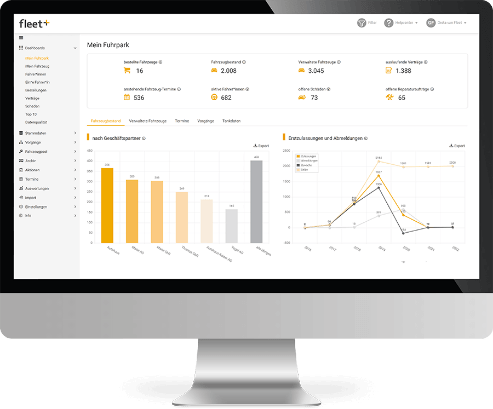
Insightful reports are a key component of professional fleet management services. Custom dashboards provide up-to-date metrics on costs, vehicle utilization, mileage, and upcoming appointments. This gives customers greater transparency and enables them to make informed decisions based on current data.
Many service providers still create reports manually. However, our experience shows that automated dashboards not only save time but also significantly improve the quality of customer communication. Up-to-date metrics can be accessed at any time and provide a solid foundation for strategic decisions.
Role and permission management
Not every user needs access to all information. With a differentiated role and permission management system, permissions can be assigned on an individual basis—for example, to administrators, customers, or external partners. This enhances data security and ensures clearly defined responsibilities.
Interfaces to existing systems
Powerful fleet management software should integrate seamlessly into existing IT environments. Interfaces with ERP systems, leasing companies, fuel card providers, or accounting solutions prevent duplicate data entry and ensure a smooth flow of information. This reduces administrative overhead and creates end-to-end digital processes.
How CarWise supports fleet management service providers
For more than three decades, CarWise has been developing software solutions for professional fleet management. During this time, the demands placed on fleet service providers have changed fundamentally—from traditional vehicle management to digitized, data-driven processes. We have been supporting this evolution for many years in partnership with our customers.
Our experience shows that successful digital transformation projects do not begin with the implementation of software, but rather with a deep understanding of existing processes. Only when workflows are analyzed, standardized, and digitized in a meaningful way can sustainable value be created for service providers and their customers.
The Carano Fleet+ fleet management software allows you to centrally manage vehicles, drivers, documents, and schedules. Automated workflows reduce administrative tasks, while comprehensive reporting features ensure transparency.
Carano Fleet+ was specifically designed to efficiently manage complex fleet processes while offering sufficient flexibility to meet individual customer needs. This allows fleet service providers to scale their services without compromising on quality or losing track of the big picture.
Conclusion
Today, fleet management service providers do much more than just traditional vehicle management: They are required to manage multiple client fleets simultaneously, reliably comply with legal requirements, and act as strategic partners to their clients. Modern fleet management software provides the necessary foundation for this: It consolidates data, automates recurring tasks, and makes processes transparent—regardless of how many vehicles or clients are being managed.
Any service provider that wants to remain competitive in the long term cannot do without a well-thought-out digitalization strategy. With Carano Fleet+, fleet service providers have access to a solution that addresses exactly this need—scalable, flexible, and tailored to the requirements of professional fleet management.
Frequently asked questions (FAQ)
A fleet management service provider handles tasks related to the administration, organization, and optimization of vehicle fleets on behalf of companies. Depending on the scope of services, these tasks include, among other things, vehicle procurement, lease management, compliance with legal vehicle owner obligations, maintenance and scheduling management, claims management, as well as reporting and cost control. Many service providers also support their clients in digitizing processes and advise them on the strategic development of their fleet management.
Fleet management service providers often manage multiple client fleets simultaneously and must keep track of numerous deadlines, documents, and legal requirements. Centralized fleet management software automates recurring tasks, reduces administrative overhead, and creates a shared database. This allows processes to be streamlined, errors to be avoided, and clients to be served more quickly and transparently.
Key features include centralized vehicle and driver management, appointment and deadline management, digital document management, claims management, cost control, and insightful reports and dashboards. Equally important are role- and permission-based access control, as well as interfaces to existing systems, so that multiple client fleets can be managed efficiently and securely.
Yes. Modern fleet management software is designed to manage multiple customers, locations, and vehicle fleets within a single centralized platform. Role-based access controls ensure that each customer can access only the information relevant to them. This allows processes to be standardized without having to compromise on individual requirements.
This way, each fleet remains clearly distinguishable, even when management is centralized through a single platform.
Professional fleet management software offers interfaces to ERP systems, leasing companies, fuel card providers, accounting solutions, and telematics systems. This enables the automated exchange of data, eliminates the need for duplicate data entry, and allows existing processes to be seamlessly digitized.
In addition to a suitable range of features, scalability, user-friendliness, and integration capabilities play an important role. For service providers in particular, a solution that can centrally manage multiple client fleets, offers flexible role and permission structures, and can be adapted to individual processes is recommended. Regular updates, reliable support, and the software provider’s extensive experience are also important selection criteria.
Modern fleet management software helps reliably organize compliance with legal requirements such as driver’s license checks, occupational safety training, maintenance schedules, and vehicle inspections. Automatic reminders, digital documentation, and centralized records make it easier to meet deadlines and create transparency—for both fleet management service providers and their customers.
Other useful articles
- Fleet management for energy providers: Efficient, digital, and reliable
- Setting up a fleet organization: Structure, processes and digital solutions