
Ensuring mobility within the company, boosting employee motivation, and at the same time efficiently keeping track of the costs for all vehicles in the fleet—these are just a few of the many demands placed on a fleet manager.
The issue of costs—or, more specifically, fleet management—is receiving increased attention, because, after all, the fleet as a whole must be financially viable.
The fleet manager therefore needs a clear overview of all operating costs and should keep a close eye on them at all times in order to identify potential cost drivers among the many vehicles and thus lay the groundwork for strategic fleet decisions.
That’s Why Fleet Management Is So Important
One thing is certain: Fleet management always pays off. However, it’s not just important which key metrics are analyzed in the fleet, but above all, how they are analyzed. The better the data is structured for fleet management, the more meaningful the results will be and the less time-consuming the subsequent data processing will be. Even though fleet management is primarily associated with cost control, other indicators also play a crucial role:
- Identifying outliers: A comparison of the respective vehicle classes with reference vehicles quickly reveals any deviations.
- Consider the vehicle’s useful life: Tracking the vehicle’s maintenance history, including repair costs per vehicle, provides insights into its optimal useful life. At what point do the costs of maintenance and repairs exceed the additional cost of a new vehicle?
- Analyzing Claims Rates: An analysis of the types of vehicle damage, as well as their frequency and timing, can provide insights into appropriate measures for reducing claims rates, such as better driver training or the installation of rearview cameras on vehicles to improve rear visibility.
- Track appointments: This ensures you always have a clear overview of pending and completed tasks, such as driver’s license renewals and vehicle inspection appointments.
Step by Step Toward Meaningful Fleet Reporting
Every fleet is structured differently, and accordingly, the requirements for fleet management vary from fleet to fleet. Therefore, the first step should be to define the requirements for the reporting tool. The challenge lies in capturing the complexity of the fleet and all its tasks as simply as possible using the most important fleet metrics. The following five questions will help you establish a meaningful fleet reporting system.
Question #1: What processes underlie the data?
Regardless of your fleet management approach (in-house or outsourced), you should ensure that you conduct both qualitative and quantitative evaluations and collect the necessary data for this purpose.
Question #2: How do I obtain the data needed for fleet management?
To ensure transparency and clarity in your fleet, it’s crucial to have the necessary data for fleet management. The best way to do this is to use appropriate fleet management software. This allows you to systematically record all relevant information and costs related to your vehicles—such as fuel consumption, maintenance intervals, and repair costs—in one place. This information serves as the basis for meaningful reports and analyses.

Modern fleet management software solutions allow you to automatically collect data for each vehicle and generate clear reports directly from the software. This gives you a quick and easy, comprehensive overview of your fleet, allowing you to make informed decisions to reduce costs and increase efficiency within your company.
Question #3: How is the information displayed?
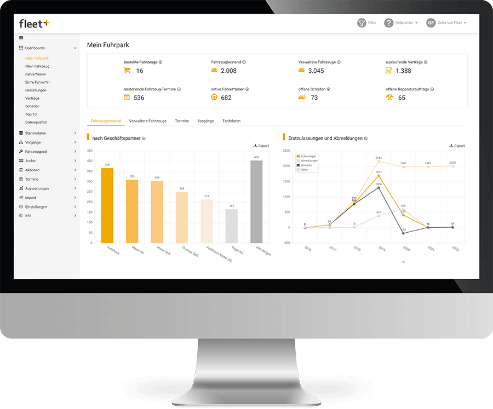
The appropriate data output is determined, among other things, by the number of data records and the intended use of the analyses performed by the software. Lists, contract overviews, or general cost center reports are suitable for large volumes of data. Attractive templates, such as dashboards providing a quick overview of the most important key performance indicators for fleet management—including graphics—also offer a useful overview. From there, users can explore further details in the analysis as needed. Traffic-light reports are also particularly useful for highlighting key fleet metrics, such as costs.
Question #4: How often is the data needed for fleet management?
Both the availability of the data and the need for it to be up-to-date have a significant impact on reporting. If reports are needed frequently, it is extremely helpful to have data on all vehicles available and to be able to generate reports quickly.
Question #5: Where can I find the relevant data and key metrics for the vehicle fleet?
Data on all vehicles and drivers should be available to all authorized contacts both within and outside the fleet. Access options via various devices should also be considered here. Based on these questions, a list of requirements emerges for the organizational and technical development of a reporting solution that enables fleet management and all stakeholders to work effectively:
- The level of detail in the reports and templates must be precisely defined for all vehicles
- Access options and policies should be tailored to reporting
- Security considerations and access restrictions for content in accordance with the GDPR must be implemented

Consolidating Diverse Data Sources for Fleet Management
A lack of transparency in fleet management certainly does not stem from a lack of data, but rather from the difficulty of consolidating, filtering, and quickly analyzing the relevant data for each vehicle into clear templates. This is because the data sources for comprehensive reporting are diverse: they can come from financial or HR accounting, index cards, Excel spreadsheets, online reporting tools from leasing providers, data feeds from fuel companies or insurance providers, and much more. The goal of any reporting should therefore be to process the incoming data reliably and transparently so that it can be used for later analysis.
This consolidation can be achieved either through a so-called data warehouse or by using appropriate fleet management software that covers all key aspects relevant to your needs and provides customized analyses.
The Carano Fleet+ fleet management software helps
A fleet management solution that supports both the management of processes and data and provides interfaces to service providers, fuel suppliers, and many others is the ideal foundation for reporting at the touch of a button. This is where our fleet management solution, Carano Fleet+, comes in, thanks to:
- Integrated dashboards that display all relevant key performance indicators (e.g., claim frequency, cost per kilometer per vehicle deployment scenario)
- Recording Comparisons for Targeted Monitoring
- Creating to-do lists (e.g., mileage tracking, expiring contracts, outstanding claims, driver and vehicle schedules)
- Implementation of a list generator for improved target group sorting (inventory lists by business partner, cost center, etc.)
Even if you have your fleet managed by one or more external service providers, Carano Fleet+ is a valuable tool because it allows you to maintain ongoing contract oversight. We at CarWise would be happy to advise and support you in your efforts to create greater transparency and clarity in your fleet and to establish meaningful fleet reporting.