 Hans-Joachim Guth
The UVV inspection for company cars is a key component of the Accident Prevention Regulations (UVV) and is therefore mandatory for every company. It ensures that company cars comply with applicable safety standards and do not pose a hazard in everyday traffic.
For fleet managers, regular inspections are not only a legal responsibility but also an important contribution to workplace safety and employee protection. In this article, you’ll learn what the UVV inspection for company cars entails, how it’s conducted, and what you need to keep in mind during the process.
Contents
- 1. What is a UVV inspection in the vehicle fleet?
- 2. What is the legal basis?
- 3. Who carries out the vehicle inspection?
- 4. Which vehicles are subject to the UVV test?
- 5. What is checked during the UVV vehicle inspection?
- 6. Download UVV vehicle inspection checklist (German only)
- 7. How much does the UVV test cost?
- 8. What obligations do drivers have during the UVV vehicle inspection?
- 9. What penalties apply if the UVV inspection is not carried out?
- 10. Digital support for UVV inspections
What is a UVV inspection in the vehicle fleet?
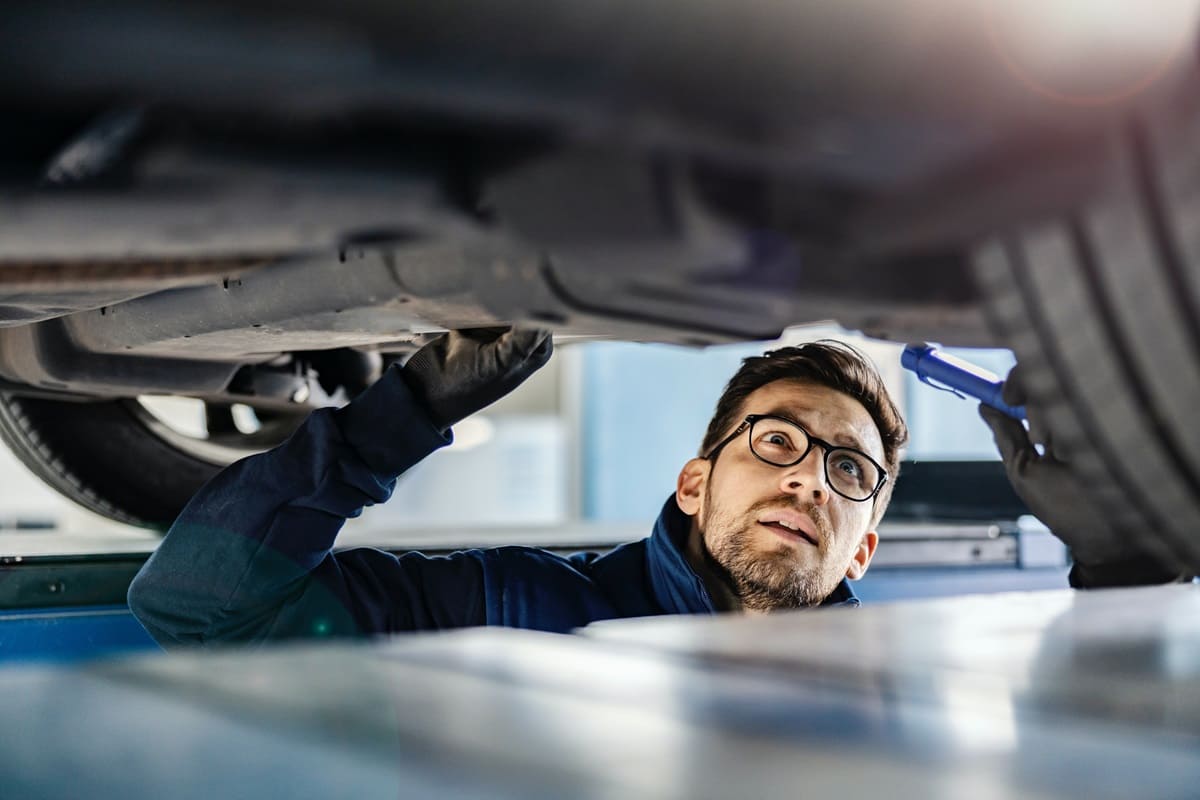
A UVV inspection of company vehicles is a legally required safety inspection designed to ensure the safety and roadworthiness of the vehicles. The vehicle inspection is part of occupational safety measures and is intended to prevent workplace accidents and occupational diseases.
The UVV inspection should not be confused with the general vehicle inspection (HU) or the emissions test (AU), which are also required by law. While the HU and AU primarily assess road safety and environmental compliance, the UVV inspection focuses on the vehicle’s workplace and operational safety.
Companies are required to conduct this inspection on a regular basis, as this is the only way to ensure compliance with applicable safety standards. Proper documentation of the results plays an important role in this process—it serves as evidence in the event of an accident or an audit by the workers’ compensation insurance provider.
Fleet managers, in particular, bear responsibility in this area, as they must ensure compliance with all legal regulations regarding workplace safety. In addition to technical inspections of company vehicles, regular occupational safety and health training sessions for drivers are required. These sessions ensure that employees are familiar with safety regulations in everyday traffic and use the vehicles correctly.
In addition, by combining UVV inspections with other processes—such as driver’s license checks or vehicle inspections —companies can develop an efficient and comprehensive safety strategy for fleet management. This applies not only to individual vehicles but also to larger fleets or shared-use vehicles, where additional considerations—such as taxation of shared-use vehicles —must be taken into account.
What is the legal basis?
The requirement to conduct the UVV inspection is governed by DGUV Regulation 70. Section 57(1) of DGUV Regulation 70 further stipulates that the inspection must be conducted at least once a year.

Section 57(1) of DGUV Regulation 70
(1) The operator shall have vehicles inspected by an expert as required, but at least once a year, to ensure that they are safe to operate.
(2) The results of the examination in accordance with paragraph 1 shall be recorded in writing and kept at least until the next examination.
Whether inspections will be conducted even more frequently depends on the nature and frequency of vehicle use and the specific regulations of the relevant workers’ compensation association. The results of the UVV inspections must always be documented and stored in a traceable manner, as this serves as proof that the inspections were carried out.
Who carries out the vehicle inspection?
Qualified, knowledgeable specialists are required to perform UVV inspections of company vehicles.
These are individuals who have received appropriate technical training and have professional experience in the field of automotive engineering. In addition, these specialists must have sufficient knowledge of all relevant UVV regulations and rules in order to successfully conduct the vehicle inspection.
Organizations such asTÜV orDEKRA have the necessary expertise and certification to conduct vehicle inspections in accordance with UVV regulations. In addition, any authorized auto repair shop is authorized to perform these inspections. Qualified fleet management companies, independent repair shops, and tire dealers also offer UVV inspections for company cars.
Many companies have their vehicles inspected as part of the annual inspection. However, tire changes or other maintenance work also provide a good opportunity to have the inspection performed. In this case, the inspection must be listed separately on the invoice.
For fleet managers, it is crucial that the UVV inspection be integrated into existing workflows not only professionally but also efficiently. Many companies combine the UVV inspection with routine inspections or internal processes, such as driver’s license checks, to save time and money.
Carrying out this process requires not only technical expertise but also a high degree of organizational skill. Comprehensive documentation is essential, as it provides proof of proper inspection in the event of a dispute or an audit by regulatory authorities or the workers’ compensation insurance provider.
This is especially true for a fleet of company carsor pool vehicles: The larger the fleet, the more complex the planning and responsibilities become. This is where comprehensive fleet management training pays off—training that covers not only technical knowledge but also topics such as UVV training and workplace safety. In this way, companies ensure that not only are the vehicles inspected, but drivers are also regularly trained on current regulations and safety standards.

Which vehicles are subject to the UVV test?
The UVV inspection for company cars applies—as it does for other vehicles—to all motor vehicles used in the course of business activities. These include:
- Passenger cars, such as company cars and fleet vehicles, that are used by employees for business purposes
- Commercial vehicles, such as delivery vans, small trucks, and panel vans
- Heavy vehicles, such as trucks, construction vehicles, tractor-trailers, and other heavy commercial vehicles
- Special-purpose vehicles, such as forklifts, construction equipment, agricultural vehicles, fire trucks, ambulances, or municipal vehicles
- Single-track motor vehicles such as motorcycles, mopeds and scooters.
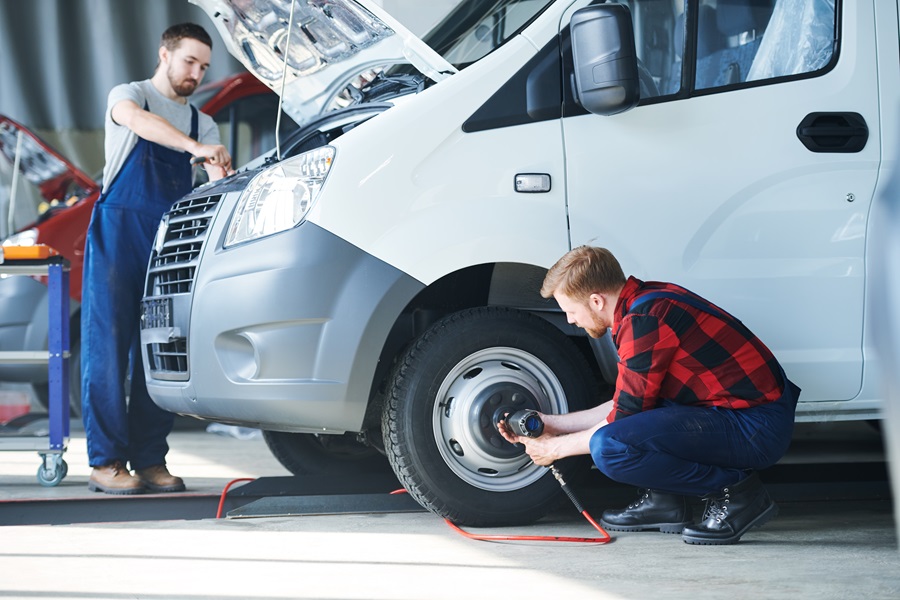
For companies with company bikes in their fleet, it is important to note that certain e-bikesare also subject to the UVV test. E-bikes that reach a speed of over 25 km/h are considered motor vehicles. They are therefore also subject to the
In addition, work machines and their vehicle-related components—such as chassis, lighting, and braking and steering systems—may also be subject to inspection. This applies provided that they are either self-propelled or used as trailers.
However, there are also a number of vehicles that are exempt from DGUV Regulation 70. These include, for example, private vehicles that are used for business purposes but are owned by employees. Specialized machinery used in earthwork (e.g., soil compactors or excavators), ground support equipment for aviation, and agricultural and forestry vehicles are also not subject to the provisions of Regulation 70.
What is checked during the UVV vehicle inspection?
As part of the UVV vehicle inspection, various components and aspects of the vehicle are checked to ensure that it is safe and in good working order. These include, among other things:
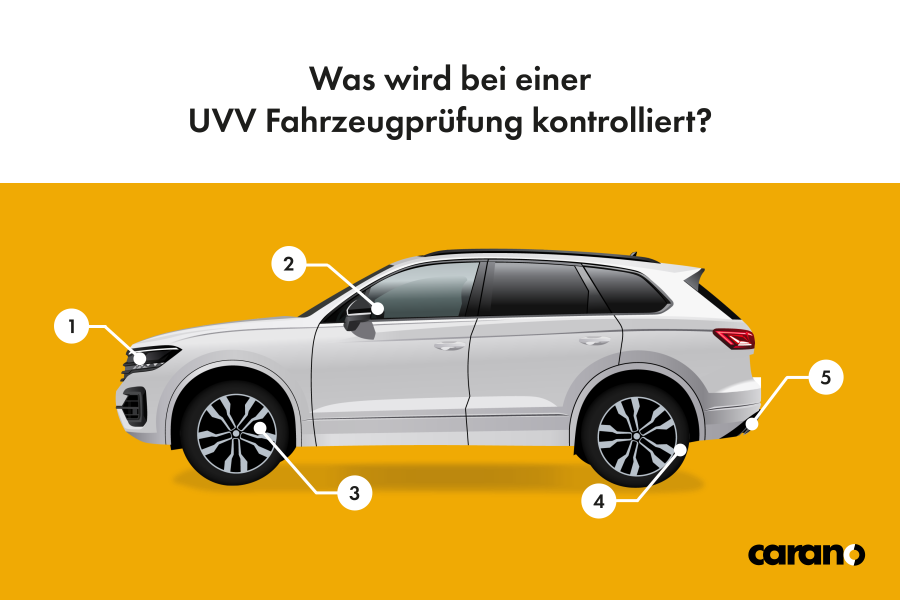
- Lighting and Electrical Systems: Headlights, taillights, turn signals, brake lights, and other electrical systems such as wiring, the starter, and the battery
- Steering: Play, Tightness, and Overall Functionality
- Brakes: Functionality and condition of the braking system, including brake pads, brake rotors, brake fluid, and parking brake
- Tires: Tire condition, including tread depth, air pressure, and any damage
- Exhaust system: Inspection for leaks, damage, or excessive exhaust emissions
In addition, the following points must also be taken into account during the vehicle inspection:
- Vehicle fluids: engine oil, coolant, and windshield washer fluid
- Safety equipment: Presence and proper functioning of safety equipment such as a first-aid kit, warning triangle, and safety vest, as well as the proper functioning and condition of seat belts
- Body: Inspection for corrosion, damage, and defects
- Visual inspection: Check the windshield, windows, and mirrors for cracks, damage, and clear visibility.
As the UVV vehicle inspection covers many different areas, it is important to keep an eye on all relevant inspection points. You can use our checklist for this purpose, which contains many important inspection points for passenger cars. In order to take account of the different vehicles and situations in your fleet, you should add individual points if necessary.
Download our checklist as a PDF for the next UVV inspection of your cars to get a quick and easy overview of the relevant inspection points.
Download UVV vehicle inspection checklist (German only)
How much does the UVV test cost?
The duration and effort required for a vehicle inspection vary depending on the type of vehicle. Prices also differ from location to location. Therefore, it is difficult to specify the exact cost of an UVV inspection. The following prices provide an overview of the approximate costs, although the size and type of the vehicle are the determining factors:
Motor vehicles: 15 to 110 euros
Stacker: 10 to 90 Euro
Lifting and working platforms: 50 to 70 euros
Cranes: 35 to 115 euros
Construction machinery: 45 to 80 euros
What obligations do drivers have during the UVV vehicle inspection?
In addition to the annual vehicle inspection by a qualified person, drivers are also required to perform regular checks on the vehicle. This is governed by Section 36(1) of DGUV Regulation 70:
(1) Before the start of each work shift, the driver must check that the controls and safety devices are in good working order and, during the work shift, monitor the condition of the vehicle for any obvious defects.
(2) The driver must report any defects discovered to the responsible supervisor and, in the event of a change in drivers, also to the incoming driver. If defects endanger operational safety, the driver must cease operations.
The goal is to identify defects and damage early on and minimize the risk of accidents . The daily vehicle inspection includes checking the lights, turn signals, and brakes, as well as tire tread depth, tire pressure, and fluid levels.
The legibility of the license plate must also be checked, and any cargo must be properly secured. If the driver notices any defects, they should be reported immediately. Fleet management must then arrange for repairs as soon as possible or temporarily take the vehicle out of service.
It is important for companies to know that these driver inspection requirements are part of the vehicle owner’s liability. This means that even though legal responsibility lies with the vehicle owner, the driver must do his or her part by complying with the required rules and documenting any irregularities.
Modern electronic systems can be used to support this process by digitally recording daily vehicle inspections and enabling automatic documentation. This allows any issues to be quickly reported to fleet management.
In addition, regular driver training is also part of the UVV requirements. These training sessions raise employees’ awareness of the proper use of UVV-compliant vehicles and promote compliance with applicable safety standards in daily operations. In addition, many companies offer specific UVV training sessions that provide practical guidance on how to conduct inspections efficiently and in compliance with the law.

What penalties apply if the UVV inspection is not carried out?
It is important to have the UVV inspection performed regularly and properly. Anyone who has the vehicle inspected only irregularly or not at all is in violation of § 209(3) of Book VII of the Social Code (SGB VII) an administrative offense and risks a fine ranging from 2,500 euros to 10,000 euros.
In the event of a claim , proof must also be provided that the required inspections have been performed; otherwise, the insurance company may refuse to pay. Furthermore, failure to have the vehicle inspected in accordance with the UVV regulations may result in legal consequences in the event of an accident.
Digital support for UVV inspections
Companies and fleet managers rely on external experts for UVV inspections. Organizing these inspections therefore usually involves a significant amount of effort. Fleet management software helps you manage schedules and automatically reminds you of upcoming and overdue deadlines, such as for UVV inspections, HU, or AU. You can assign all documents and vehicle records—such as inspection reports—to the corresponding vehicle and save them in the digital vehicle file. In this way, fleet management software can help you comply with vehicle owner liability requirements.
Especially for larger fleets, it is helpful to keep track of all vehicles covered by the UVV to schedule inspections in a timely manner in accordance with applicable regulations and avoid downtime.
Conclusion
- In addition to driver training, the UVV inspection is essential for ensuring compliance with the vehicle owner’s liability obligations within the fleet. Inspecting all vehicles in the fleet is intended to prevent accidents and ensure workplace safety.
- It is not only passenger cars that are subject to mandatory inspections; all vehicles used for business purposes must also be inspected. During the inspection, a specialist examines all necessary components, such as tires, brakes, and lights.
- Fleet management software can remind fleet managers of important deadlines and thus contribute to compliance with the inspection obligation.
FAQ – Important questions on the subject of UVV inspections
Yes, the UVV inspection (Accident Prevention Regulation) is required by law for company vehicles in Germany. Under Section 57 of DGUV Regulation 70, employers are required to have their vehicles inspected regularly for safety and defects in order to prevent accidents and ensure road safety.
The UVV inspection must be conducted at least once a year. In addition, employers are required to have the vehicles inspected for visible defects before each use. If a defect is found, it must be corrected immediately to ensure operational safety.
A qualified inspector checks company vehicles for required safety-related aspects such as brakes, lights, tires, steering, and general roadworthiness. The inspection includes both a visual inspection and a functional test. After the inspection is passed, an inspection report is issued to serve as proof of compliance.
If the UVV inspection is not conducted, the company faces legal consequences, including fines and liability risks in the event of damage. Furthermore, in the event of an accident, this may result in insurance companies denying coverage and the employer being held liable for damages.
During the UVV inspection of company vehicles, all safety-related components and functions are checked—such as brakes, lights, steering, tires, seat belts, and technical equipment. The goal is to ensure workplace safety and comply with legal regulations.
UVV inspections of company vehicles may only be performed by qualified, knowledgeable professionals—for example, by TÜV, DEKRA, or authorized auto repair shops. Specialized fleet management service providers may also conduct the inspection, provided that proper documentation is maintained.
Other useful articles on the subject of UVV inspections and vehicle fleets
- Company car costs for employers: everything you need to know
- Employer Driving License Check: Legal Regulations and Tips for Implementation
- Car Policy: Significance and advantages of a company car policy in the vehicle fleet
- Sustainable mobility starts with the vehicle fleet: electrification & environmental measures
- Owner liability in the fleet: These obligations apply to fleet managers